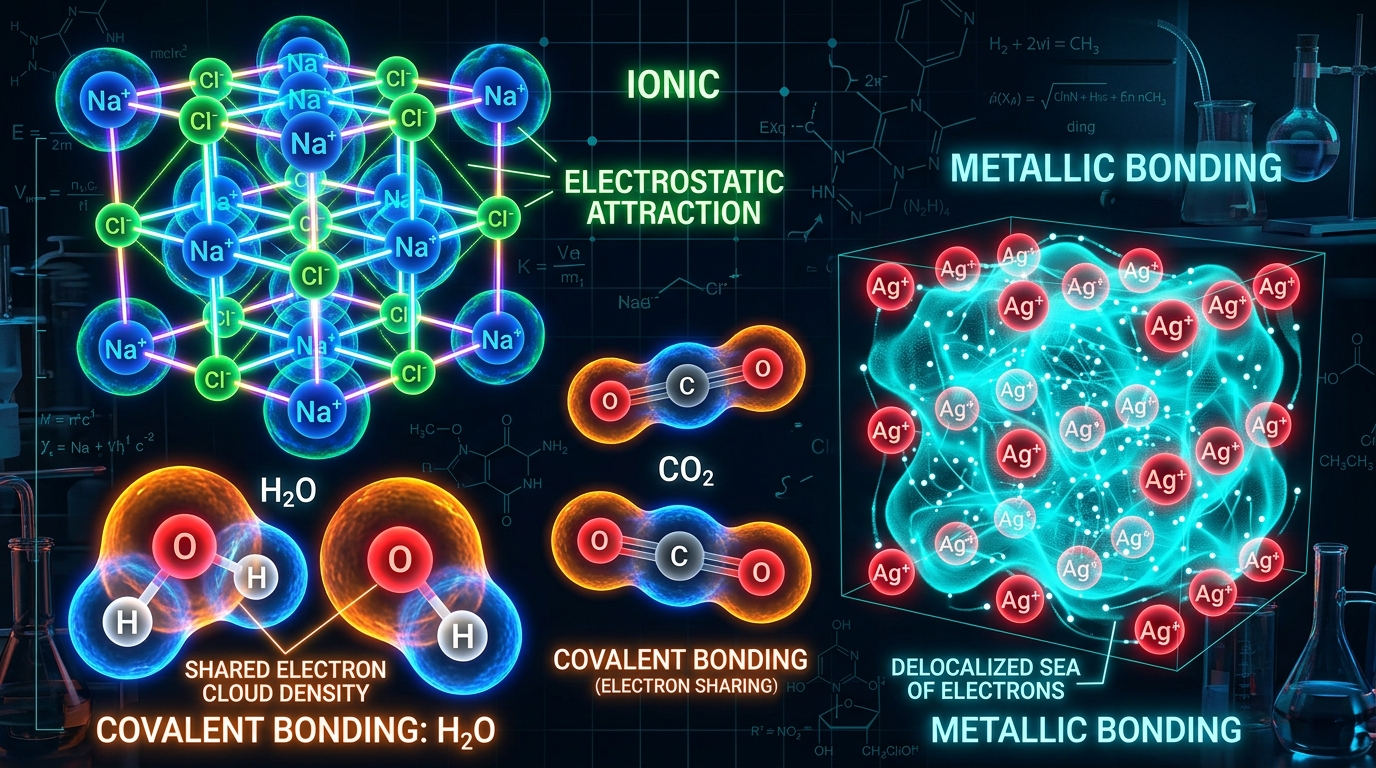
Types of Chemical Bonds
Chemical bonds are the forces that hold atoms together to form molecules and compounds. Atoms bond to achieve lower energy and greater stability.
1. Ionic Bond
An ionic bond is formed when one atom completely transfers one or more electrons to another atom, forming oppositely charged ions that attract each other.
How it forms
- Occurs between a metal and a non-metal
- Metal loses electrons → becomes a cation (+)
- Non-metal gains electrons → becomes an anion (−)
- Electrostatic attraction holds ions together
Example
Sodium Chloride (NaCl)
Na → Na⁺ + e⁻
Cl + e⁻ → Cl⁻
Properties
| Melting point | High |
| Electrical conductivity | Yes (molten / aqueous) |
| Solubility | Often soluble in water |
| Bond strength | Strong |
2. Covalent Bond
A covalent bond is formed when two atoms share one or more pairs of electrons to achieve stability.
How it forms
- Occurs between non-metal atoms
- Electrons are shared, not transferred
- Bond is directional
- Forms molecules
Examples
- H₂O — Water
- CO₂ — Carbon dioxide
- O₂ — Oxygen
Types of Covalent Bonds
| Type | Electron Pairs | Example |
|---|---|---|
| Single | 1 | H–H |
| Double | 2 | O=O |
| Triple | 3 | N≡N |
Polar vs Non-Polar
- Polar: Unequal sharing (H₂O)
- Non-polar: Equal sharing (O₂, N₂)
3. Metallic Bond
A metallic bond is formed when positive metal ions are surrounded by a sea of delocalized electrons.
Electron Sea Model
- Valence electrons are free to move
- Explains electrical conductivity
- Non-directional bond
Examples
- Iron (Fe)
- Copper (Cu)
- Aluminium (Al)
Properties
| Conductivity | High |
| Malleability | High |
| Ductility | High |
Comparison of Chemical Bonds
| Property | Ionic | Covalent | Metallic |
|---|---|---|---|
| Electron behavior | Transferred | Shared | Delocalized |
| Conductivity | High (solution) | Low | High |
| Melting point | High | Low | Variable |
Dot–Cross Diagrams
Dot–cross diagrams show the transfer or sharing of electrons using different symbols for different atoms.
Na • → Na⁺ Cl ××××××× + • → Cl⁻ H • : O : • H
Electronegativity Difference Simulator
3D Bond Models
Visual representations to support theoretical understanding of chemical bonds
Electron transfer forms oppositely charged ions
Example: NaCl
Shared electron pair holds atoms together
Example: H₂, O₂
Delocalized electrons enable conductivity
Example: Cu, Fe