Best Free Virtual Science Labs for Students in 2026 (No Download Required)
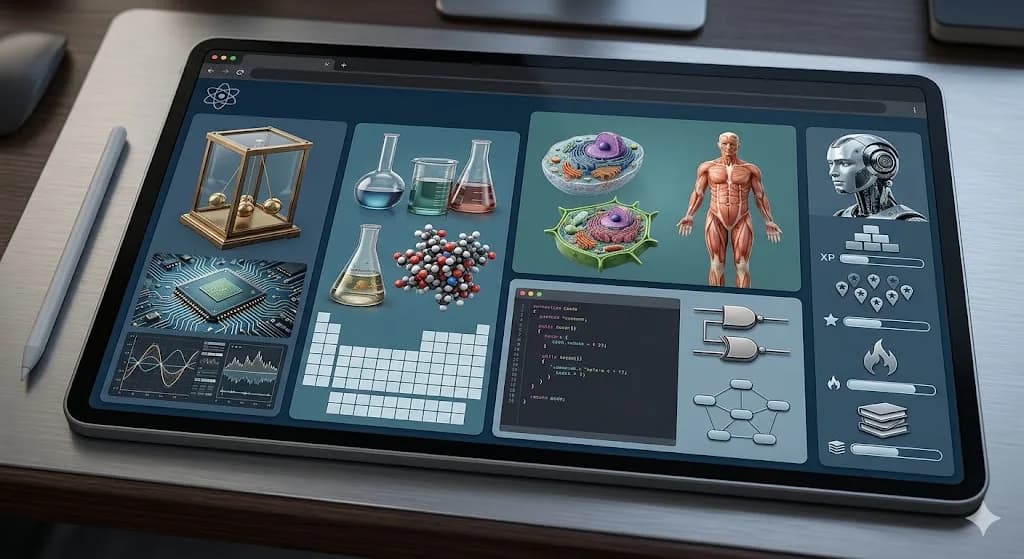
Whether you're a student cramming for exams, a teacher building a digital curriculum, or a parent looking for something better than YouTube for your child's science homework — virtual labs have become one of the most powerful learning tools available today.
The best part? You don't need expensive equipment, a school lab, or even a powerful computer. Everything runs entirely in your browser.
This guide covers what makes a virtual science lab actually worth your time in 2026, what to look for, and why the bar has been raised significantly this year.
What Makes a Good Virtual Science Lab?
Before getting into what's available, it's worth knowing what separates a great virtual lab from a glorified textbook with animations.
A good virtual lab should:
- Let you change parameters and see results in real time — not just watch a video
- Work on any device, without downloading anything
- Cover multiple subjects or go very deep on one
- Give you feedback — not just a simulation that runs silently
- Be actually free — not a 7-day trial masquerading as free
Most platforms available today tick one or two of these boxes. Very few tick all of them.
The Problem With Most Virtual Labs
The virtual science lab space has a few persistent problems that haven't been solved until recently.
No reason to come back. Most platforms give you a simulation, you play with it once, and that's it. There's no progression, no goal, no reason to return tomorrow. For students, this means the habit never forms.
No guidance when you're stuck. You're dropped into a simulation with no context. If you don't understand why changing one parameter affects another, the simulation doesn't help you figure it out — you're on your own.
Computer Science is almost entirely absent. The virtual lab space has historically focused on Physics, Chemistry, and Biology. Students learning programming, data structures, networking, or digital logic have had nowhere to go for interactive, browser-based labs.
Outdated technology. Many established platforms were built over a decade ago and haven't kept pace with modern web technology. They work, but they don't feel good to use — which matters more than people admit when it comes to student engagement.
What 2026 Actually Looks Like
The standard has shifted. Students in 2026 expect the same quality from educational tools that they get from the apps they use every day. Static simulations and passive content no longer cut it.
The virtual labs worth using in 2026 share a few characteristics:
- Real-time interactivity — parameters change outcomes instantly, not after a loading screen
- AI integration — not as a gimmick, but as a genuine assistant that understands context
- Gamification that means something — not just points for clicking, but structured progression that rewards genuine learning
- Cross-subject coverage — students don't study in silos, and their tools shouldn't either
OpenLabs — Built for How Students Actually Learn
Website: openlabs.org.in Subjects: Physics, Chemistry, Biology, Computer Science Cost: 100% Free
OpenLabs is a browser-based virtual laboratory platform covering four major science subjects with 25+ interactive experiments. No download, no installation, no paywall.
What's Inside
Physics Free Fall, Projectile Motion, Simple Pendulum, Hooke's Law, Ohm's Law, RC Circuits, Wave Optics, Speed of Light, Uniform Motion, and Energy Conservation — each with real-time parameter controls and live graphs.
Chemistry An interactive Periodic Table with detailed element data, Chemical Bond Visualizer covering ionic, covalent, and metallic bonding, Electronic Configuration visualizer, and a 3D Reaction Simulator.
Biology Fully interactive 3D Animal and Plant Cell models where you can click individual organelles to explore their function. A Human Anatomy Explorer for anatomical structures and biological information.
Computer Science This is where OpenLabs stands entirely alone. A live HTML/CSS/JS code editor with real-time preview, a JavaScript Visual Debugger that lets you step through code and watch memory and the call stack update in real time, a DSA Visualizer, Logic Gates simulator, Git Simulator, Blockchain Explorer, and a Networking Lab. No other free browser-based platform comes close to this.
The AI Assistant
Every lab on OpenLabs has a built-in AI assistant that is context-aware. It knows which experiment you have open, what parameters you're working with, and what the experiment is trying to demonstrate.
Ask it why the pendulum period doesn't change when you increase the mass — it won't give you a generic physics explanation. It'll answer in the context of your current simulation, walk you through the reasoning, and suggest what to try next.
This is the difference between having a tutor in the room and having a search engine open in another tab.
The Gamification System
In 2026, OpenLabs launched a full progression system designed around one goal: giving students a genuine reason to come back every day.
XP and Leveling Every experiment you complete earns XP. As your XP grows you level up — both overall and within each subject separately. You can be a Level 4 Physicist and a Level 2 Chemist at the same time, with your profile showing exactly where you stand in each subject.
Daily Challenges This is the most distinctive feature on the platform. Every lab gets a new AI-generated challenge each day. Instead of just running a simulation freely, you're given a specific target to hit — for example, in the Free Fall lab you might be told to adjust the parameters so the ball lands in exactly 2.3 seconds. The challenge doesn't tell you how. You have to figure it out — and if you get stuck, the AI assistant is there to guide you through the reasoning without giving you the answer directly.
Challenges reset every 24 hours. Complete them consistently and your challenge streak grows.
Subject Mastery Each subject has its own progression track. Completing Physics experiments and challenges builds your Physics mastery separately from Chemistry, Biology, or CS. Your profile shows your level in each subject, making it easy to see where you're strongest and where you need more practice.
Badges Earn achievements for first completions, streak milestones, challenge wins, and subject mastery thresholds. Badges can be pinned to your profile.
Activity Streaks Come back daily to keep your streak alive. The streak system creates a simple but powerful habit loop — the same mechanism behind the most engaging learning apps in the world, now applied to actual science experiments.
Who It's For
Students — The daily challenge system means you have a fresh goal every time you open the platform. The AI assistant means you're never stuck without help. The progression system means your effort is tracked and rewarded. This is the closest thing to a science game that is also genuinely educational.
Teachers — The Computer Science labs alone make OpenLabs worth recommending to any student studying programming or digital systems. The XP and streak system handles the motivation problem for you — students have a built-in reason to engage beyond the classroom.
Parents — No registration wall to start exploring. Works on any device. Covers all major subjects. The progression system gives your child visible, trackable progress — which is far more motivating than a textbook with no feedback loop.
Exam Preparation — The experiment catalog covers standard high school and early college Physics, Chemistry, and Biology topics. Working through labs actively rather than passively reading theory is one of the most effective exam preparation strategies available.
Honest Limitations
OpenLabs is a newer platform. The total experiment count — currently 25+ — is lower than some established alternatives. New labs are being added continuously, and Mathematics is the next subject coming to the platform, but if you need a simulation for a very niche topic it may not be there yet.
What to Look For in Any Virtual Lab
If you're evaluating virtual labs beyond OpenLabs, here's the checklist that actually matters in 2026:
Real interactivity — Can you change parameters and see results change instantly? If not, it's a video with extra steps.
Cross-device compatibility — Does it work on your phone without an app download? In 2026 this is a basic requirement.
Feedback mechanisms — Does the platform tell you anything about your results, or does it just run silently?
AI or guided assistance — When you get stuck, what happens? Is there anything to help you understand, or are you on your own?
A reason to return — Is there any progression, any daily goal, any streak? If not, you'll use it once and forget about it.
Computer Science coverage — If you're studying CS or want to, check whether the platform covers it at all. Most don't.
The Bottom Line
The virtual lab landscape in 2026 is better than it has ever been. The combination of modern web technology, AI integration, and thoughtful gamification has produced something that didn't exist a few years ago — a platform that teaches science and builds a daily learning habit at the same time.
OpenLabs is free, requires no download, covers four subjects including Computer Science, has an AI assistant that actually understands context, and now has a daily challenge and progression system that gives students a real reason to come back.
If you haven't tried it yet, start here.
Something missing from this guide? Reach out through our contact page — we update our content regularly.
Frequently Asked Questions
Quick answers to common questions about this topic.