This question comes up a lot — usually framed as a choice between two opposing things, as if picking one means abandoning the other.
It isn't really that kind of decision.
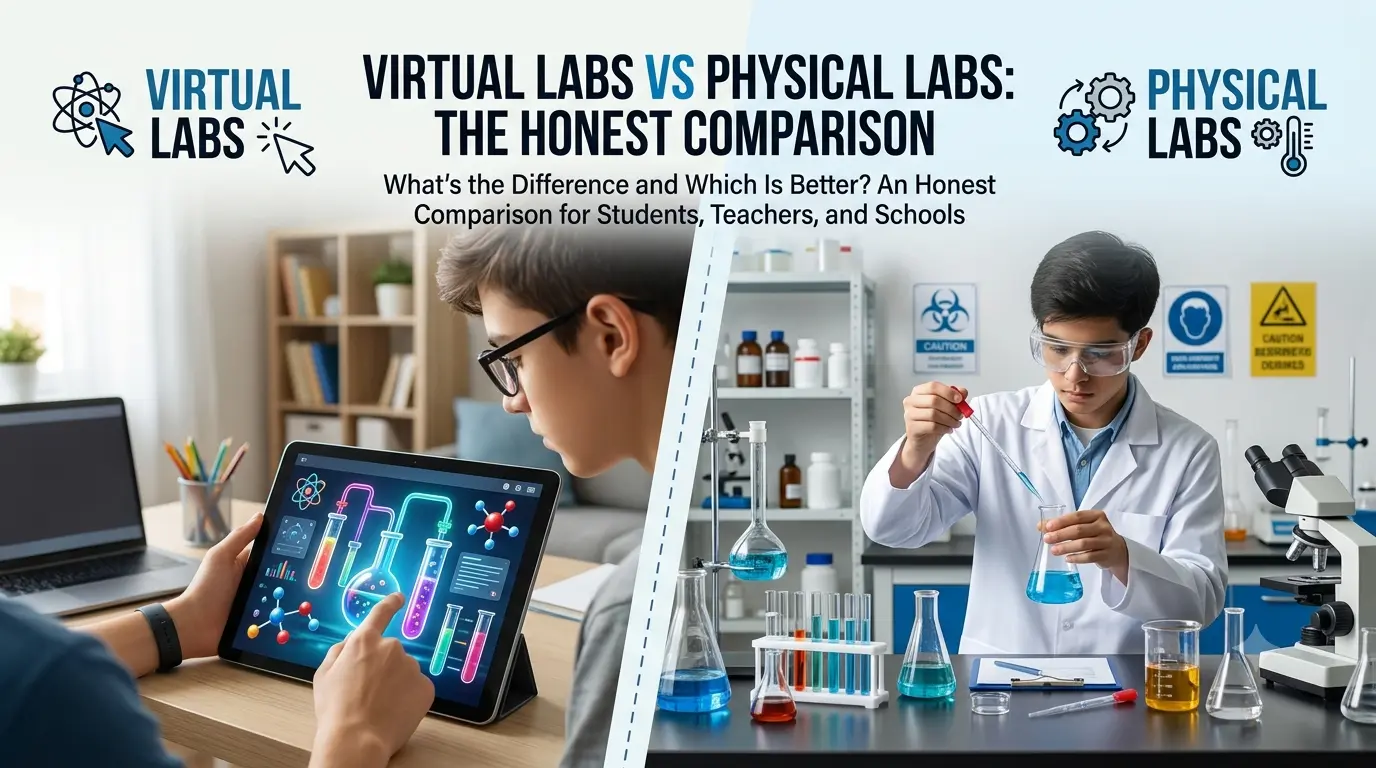
Virtual labs and physical labs are good at different things. Understanding which one is better at what is more useful than declaring a winner — especially for students trying to figure out how to study, teachers planning lessons, and schools evaluating where to invest.
TL;DR: Virtual labs give you access, repeatability, safety, and zero setup cost. Physical labs give you hands-on equipment skills, measurement experience, real-world unpredictability, and the kind of learning that only comes from doing something with your hands. Both belong in a complete science education. The question isn't which one to use — it's when to use which.
What Each One Actually Does
Before comparing them, it helps to be precise about what each format is actually doing.
A physical lab puts real materials, equipment, and measurement tools in a student's hands. The experiment has friction — things don't always go as planned, measurements need to be taken carefully, equipment can malfunction, and the result may differ from the textbook value. That friction is part of the learning.
A virtual lab runs a computer model of a scientific process in a browser. The student controls variables and observes how the model responds. There's no equipment to set up, no materials to waste, no safety hazard to manage. The result is consistent and immediate. The friction is removed by design.
Neither of those descriptions is a criticism. They're just different tools shaped for different purposes.
Head-to-Head: How They Compare Across What Actually Matters
Access and Availability
Virtual labs win clearly here.
A physical lab requires a scheduled period, available equipment, enough materials for every student group, and a teacher or lab technician present to supervise. In many schools — particularly those with large class sizes, limited budgets, or shared lab facilities — this means students get limited hands-on time, and some experiments never happen at all.
A virtual lab is available the moment a student opens a browser. At 10 PM before an exam. In a school with no functioning lab. On a revision day when the physical lab is booked for another class. There's no scheduling, no waiting, and no limit on how many students can run the same simulation at the same time.
For students in schools with under-resourced labs, or for anyone studying outside school hours, this difference is significant.
Cost
Virtual labs win again — with a caveat.
Physical labs have ongoing costs: chemicals that get used up, equipment that breaks or becomes outdated, safety materials, and the time cost of setup and cleanup. For schools running multiple practical sessions per year across hundreds of students, these costs add up.
Most browser-based virtual labs are free to access. OpenLabs, for example, provides free physics, chemistry, biology, and computer science labs with no subscription and no software install required.
The caveat: virtual labs still require devices and a reliable internet connection. For schools or students without consistent device access, the cost advantage of virtual labs doesn't fully materialise.
Safety
Virtual labs are inherently safer — but that's not always an advantage.
In a virtual lab, there are no hazardous chemicals, no open flames, no electrical risks, and no broken glass. Students can run a reaction simulation or a circuit experiment without any of the precautions a physical version would require.
That's genuinely useful for certain topics — particularly in chemistry, where some experiments involve reagents that are expensive, hard to source, or genuinely dangerous at the secondary school level.
But learning to work safely is a science skill. Students who only ever run virtual chemistry experiments haven't learned how to handle chemicals, use a fume hood, or follow a safety protocol — all of which matter in higher education and professional science environments. Physical labs teach safety through practice, not just instruction.
Repeatability and Experimentation
Virtual labs win — and this is one of their most underrated advantages.
In a physical lab, repeating an experiment means resetting equipment, replacing materials, and often waiting for the next available session. A single class period might give each student group one or two runs of an experiment.
In a virtual lab, a student can reset and repeat in seconds. Run the projectile simulation at five different launch angles. Test Ohm's Law at ten different resistance values. Compare cell structures side by side. Restart the logic gate activity until the pattern is clear.
This repeatability matters because science understanding is built through pattern recognition across multiple observations — not a single run. Virtual labs make that kind of iterative experimentation practical in a way that physical labs, constrained by time and materials, often can't match.
Hands-On Skill Development
Physical labs win — and this gap is real.
There are things a student learns only by doing them with their hands: how to use a voltmeter, how to pipette accurately, how to focus a microscope, how to handle glassware without breaking it. These are practical skills that no simulation can fully replicate.
For students heading into science or engineering at university, practical skills matter. Lab courses at degree level assume a baseline of equipment familiarity. Students who arrive with strong virtual lab experience but no physical lab exposure may find the transition harder than expected.
This isn't an argument against virtual labs — it's an argument for making sure physical lab time still happens when it can. Virtual labs support understanding; physical labs build capability.
Depth of Understanding
Roughly equal — with important nuances.
Virtual labs can help students understand why something happens more quickly than physical labs, because the feedback is immediate and the variables are isolated. A student who can't see why V = IR from a textbook often gets it within minutes in a circuit simulation, because the numbers update in real time as values change.
Physical labs can generate deeper understanding of how science actually works — with all its messiness, variation, and uncertainty. When a physical experiment gives a result that doesn't match the theory, that's not a failure; it's an opportunity to understand error, measurement, and the gap between models and reality. Virtual labs, where the model is always accurate, don't teach that lesson.
For conceptual understanding, virtual and physical labs are closer than most people expect. For understanding science as a practice, physical labs have an edge that's hard to replicate.
Exam and Practical Preparation
Both — used together.
For board exam practical preparation, virtual labs are useful for understanding procedures and expected observations before entering the physical lab. A student who has already run an Ohm's Law simulation ten times and understands the pattern arrives at the physical session with a clearer idea of what they're measuring and why.
The physical session then becomes more productive, because students spend less time confused about the aim and more time focused on accurate execution.
For written theory papers that include questions about experimental methods and observations, virtual lab experience gives students something concrete to draw on — they've seen the variables respond, not just read about them.
What the Research Says
Studies on virtual vs physical labs consistently find that neither format is universally superior. Virtual labs tend to produce equal or better results for conceptual understanding, while physical labs retain an advantage for procedural skill development and transferable lab technique. The most consistently effective approach across the research is blended use — virtual labs before or after physical sessions, rather than as a replacement for them.
This matches what experienced teachers tend to find in practice: students who come to a physical lab having already explored the concept virtually tend to get more out of the physical session. And students who revisit a concept in a virtual lab after a physical session tend to consolidate understanding better than those who only do one or the other.
So Which Should You Use?
The honest answer is: both, where possible — and virtual labs alone when physical access isn't available.
Here's a practical breakdown by situation:
If you're a student studying for exams: Use virtual labs to understand the concept and revise procedures. Use physical labs when you have access to build the practical skills your exam and future coursework will expect.
If you're a teacher planning lessons: Use virtual labs for concept introduction, pre-lab preparation, and homework or revision. Keep physical lab time for skill development, assessment, and the kind of learning that only happens with real equipment in hand.
If you're a school evaluating tools: Virtual labs don't require significant investment and remove the access barriers that prevent many students from engaging with practical science at all. They're worth adding to your toolkit. They shouldn't be used as a justification for reducing physical lab time where it's still possible to run it.
Try OpenLabs — Free Virtual Labs for Class 6 to 12
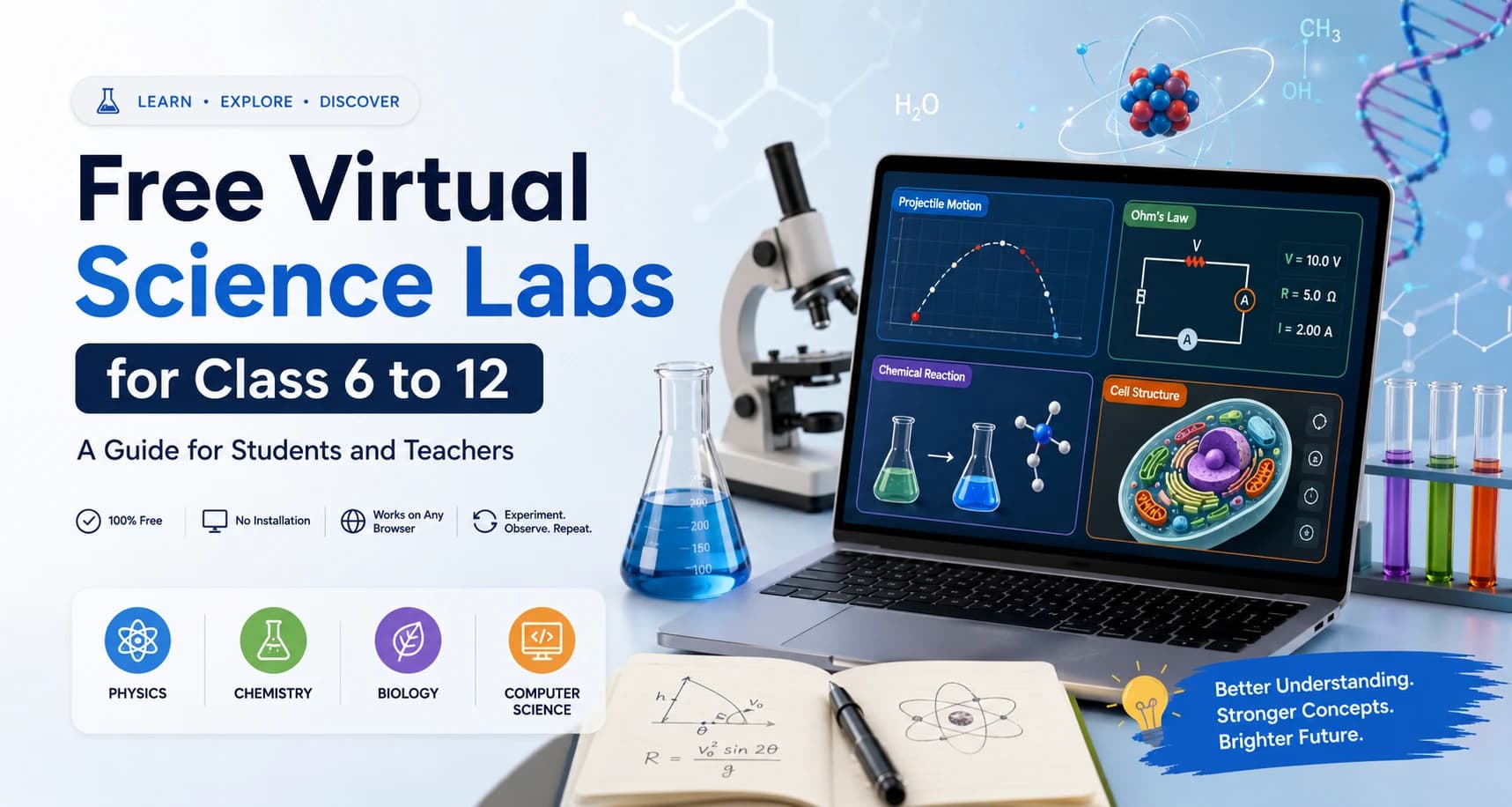
OpenLabs offers free, browser-based virtual labs across physics, chemistry, biology, and computer science — built for secondary and senior secondary students, no software install required.
If you're using virtual labs alongside physical sessions, or if physical lab access is limited right now, it's a practical place to start: