Ask most students what photosynthesis is and they'll say something like "plants use sunlight to make food." That's not wrong — but it's so simplified that it leaves out everything that actually matters for understanding the process, passing exams, and appreciating how remarkable it really is.
This guide covers what photosynthesis actually does, the misconceptions that cost students marks, and how to use an interactive simulation to build the kind of intuition that makes the topic stick.
What Photosynthesis Actually Is
Photosynthesis is the process by which plants convert light energy into chemical energy stored in glucose. The overall equation you've seen before:
6CO₂ + 6H₂O + light energy → C₆H₁₂O₆ + 6O₂
But this equation hides almost everything interesting about the process. It makes photosynthesis look like one step when it's actually two distinct stages happening in different parts of the chloroplast.
The Two Stages
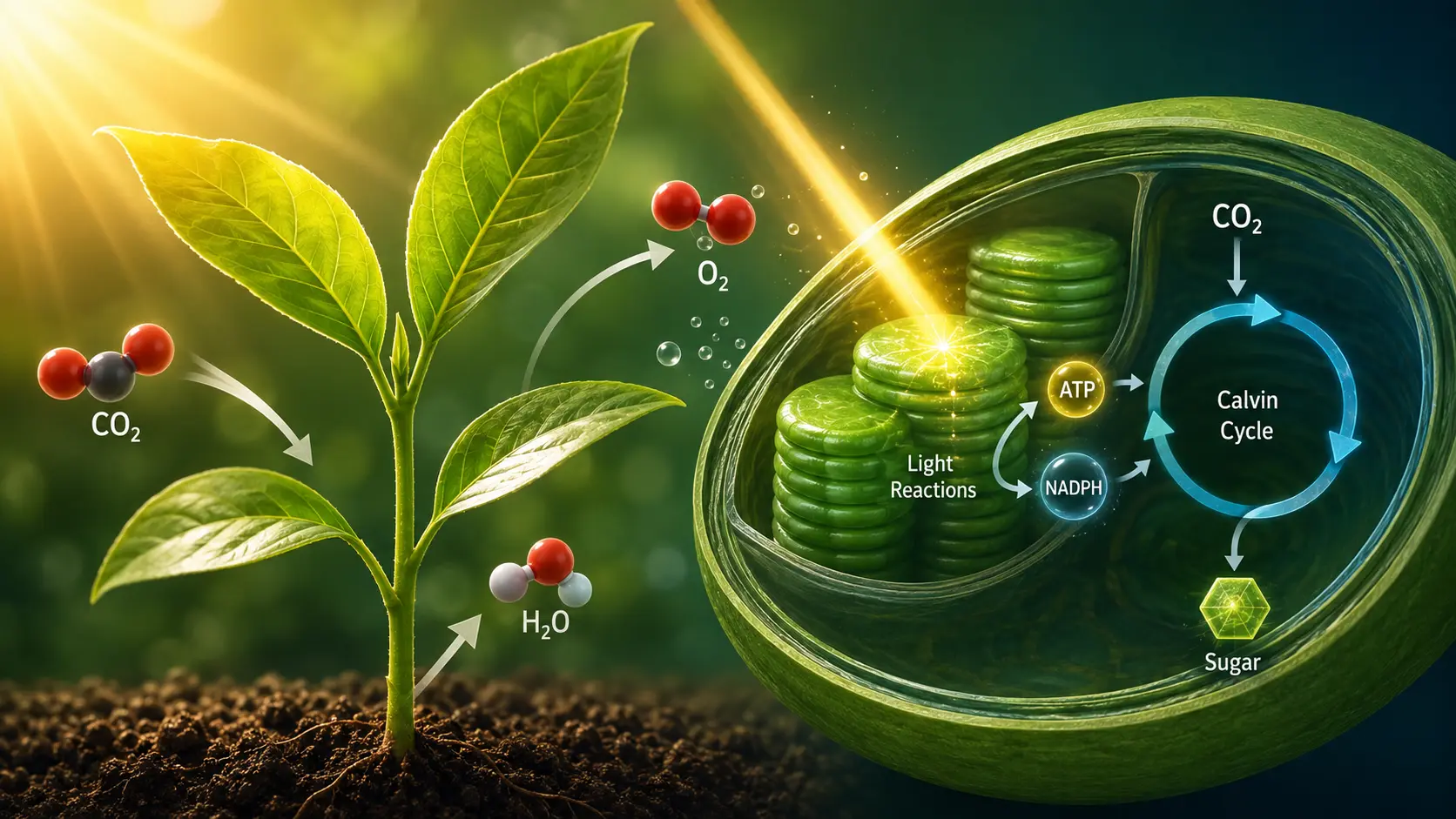
Stage 1 — The Light-Dependent Reactions
These happen in the thylakoid membranes inside the chloroplast. Here's what actually occurs:
- Light hits chlorophyll molecules and excites electrons to a higher energy state
- Those energized electrons pass through an electron transport chain, releasing energy that's used to produce ATP and NADPH
- Water molecules are split (photolysis) to replace the electrons — this is where the oxygen you breathe comes from
- The end products are ATP, NADPH, and oxygen
The oxygen released during photosynthesis doesn't come from carbon dioxide. It comes from water. This surprises most students.
Stage 2 — The Light-Independent Reactions (Calvin Cycle)
These happen in the stroma of the chloroplast. They don't require light directly — they use the ATP and NADPH produced in stage 1:
- Carbon dioxide from the air is fixed (attached) to a 5-carbon molecule called RuBP
- This produces an unstable 6-carbon compound that immediately splits into two 3-carbon molecules (GP)
- ATP and NADPH are used to convert GP into G3P (glyceraldehyde-3-phosphate)
- Most G3P is used to regenerate RuBP, keeping the cycle going
- Some G3P is used to synthesize glucose and other organic molecules
The Calvin Cycle is often called "light-independent" not because it can't happen in light — it can and usually does — but because it doesn't directly require light energy. It requires the products of the light-dependent reactions.
Blackman's Law of Limiting Factors
This is where the biology gets genuinely interesting and where the simulation becomes essential.
Blackman's Law states that the rate of photosynthesis is limited by whichever factor is in the shortest supply. In other words, you can have perfect light intensity, but if CO₂ concentration is too low, increasing light further won't help.
The four main limiting factors are:
Light intensity — More light means more energy for the light-dependent reactions, up to a point. Beyond the saturation point, more light has no effect.
Carbon dioxide concentration — More CO₂ means more substrate for the Calvin Cycle. This is often the limiting factor in natural conditions since CO₂ makes up only 0.04% of air.
Temperature — The Calvin Cycle involves enzymes. Higher temperature increases reaction rate up to the optimum, then enzyme denaturation causes a sharp drop.
Water availability — Water is both a raw material (used in photolysis) and a regulator (stomata close in drought to prevent water loss, which also blocks CO₂ entry).
The key insight: these factors interact. You can't just optimize one and expect unlimited improvement. The rate is always limited by the factor that's most constrained.
The Misconceptions That Cost Marks
1. "Plants get their mass from soil"
This is probably the most widespread misconception in all of biology. When a tree grows from a seed to a hundred-kilogram trunk, where does that mass come from?
Most people instinctively say soil. The answer is air.
The carbon in plant tissue comes from carbon dioxide absorbed through the stomata. The mass of a tree is essentially solidified air — carbon extracted from CO₂ and built into organic molecules via the Calvin Cycle.
The soil provides minerals (nitrogen, phosphorus, potassium etc.) but these are a tiny fraction of a plant's mass. The bulk comes from atmospheric CO₂.
2. "Plants only photosynthesise, they don't respire"
Plants respire all the time — day and night, in every living cell. Respiration and photosynthesis are separate processes happening simultaneously.
During daylight, photosynthesis usually produces more oxygen than respiration consumes, so the net effect appears to be oxygen release. At night, only respiration occurs, so plants take in oxygen and release CO₂.
The confusion arises because students treat photosynthesis and respiration as opposites that cancel each other out, when they're actually independent processes occurring in different organelles (chloroplasts vs mitochondria).
3. "Oxygen in photosynthesis comes from CO₂"
The overall equation shows CO₂ and H₂O as inputs and O₂ as output, which makes it tempting to think the oxygen comes from CO₂. It doesn't.
Isotope labeling experiments confirmed that the oxygen released during photosynthesis comes from water, not carbon dioxide. The water molecule is split during the light-dependent reactions (photolysis), releasing oxygen as a byproduct.
4. "Light-independent reactions don't happen in the light"
The name is confusing. "Light-independent" means the reactions don't directly use light energy — not that they only happen in the dark. In a living plant, both stages typically run simultaneously during daylight hours. The Calvin Cycle keeps running as long as it has ATP and NADPH, which the light-dependent reactions keep supplying.
5. "More light always means more photosynthesis"
Not true once you hit the light saturation point. Beyond a certain intensity, photosynthesis plateaus because some other factor — usually CO₂ or temperature — becomes limiting. This is exactly what Blackman's Law predicts.
How to Use the Simulation to Understand This
The OpenLabs Photosynthesis Simulator lets you control all four limiting factors simultaneously and watch the rate of photosynthesis change in real time.
Here's the approach that builds genuine understanding:
Step 1 — Establish a baseline Set all sliders to moderate values. Note the current rate of photosynthesis shown on the graph.
Step 2 — Test one factor at a time Increase light intensity while keeping everything else fixed. Watch the rate increase — then plateau. That plateau is where light is no longer the limiting factor.
Step 3 — Find the actual limiting factor Once you've hit the plateau on light, increase CO₂ concentration. If the rate jumps again, CO₂ was the limiting factor at that point — exactly what Blackman's Law predicts.
Step 4 — Test temperature Set light and CO₂ high, then vary temperature. Watch the rate increase to an optimum, then drop sharply as enzyme denaturation kicks in.
Step 5 — Build a mental model After experimenting, try to predict what will happen before moving a slider. If you can consistently predict the outcome — you understand Blackman's Law intuitively, not just as a statement.
Open the Photosynthesis Simulator on OpenLabs — free, no download.
Worked Example: Exam-Style Question
Question: A student measures the rate of photosynthesis in a plant at 20°C and normal CO₂ concentration. She doubles the light intensity but the rate doesn't increase. Explain why, and suggest what she could change to increase the rate.
Answer: At this point, light intensity is no longer the limiting factor — the rate of photosynthesis has reached saturation for the current conditions. Either CO₂ concentration or temperature (or both) is now limiting the rate.
To increase the rate, she could:
- Increase CO₂ concentration (most likely to help in typical conditions)
- Increase temperature (up to the enzyme optimum, around 25-35°C for most plants)
This is a direct application of Blackman's Law of Limiting Factors.
Why This Matters Beyond the Exam
Understanding photosynthesis limiting factors isn't just exam knowledge. It's why:
- Greenhouses pump in extra CO₂ to increase crop yield
- Plants grow faster in summer than winter even on bright winter days (temperature limiting)
- Deforestation affects atmospheric CO₂ and climate at the same time
- Aquatic plants bubble oxygen faster under bright light (you can watch this in real lab conditions)
The simulation makes these real-world connections visible in a way that a textbook diagram simply can't.
Try the Photosynthesis Simulator — adjust light, CO₂, water, and temperature in real time.
Have a question about a specific aspect of photosynthesis? The AI assistant in the lab can walk you through any concept in the context of your current simulation settings.