Chemistry is one of the most visual, dynamic subjects in science — and one of the most commonly taught through static diagrams and memorized equations.
You read about combustion. You copy the balanced equation. You memorize that products are formed. But you never see the atoms rearranging, never observe what happens when you change the temperature or concentration, never watch an endothermic reaction absorb energy in real time.
That disconnect between theory and observation is why chemistry feels abstract and why students struggle to apply concepts they can technically recite. A chemical reaction simulator closes that gap — not by replacing the chemistry, but by making it visible, interactive, and repeatable.
This guide covers what chemical reaction simulators actually teach, the types of reactions you need to understand, the concepts that click instantly when you see them animated, and how to use simulation to build the kind of chemistry intuition that makes exam questions feel straightforward.
What a Chemical Reaction Simulator Actually Does
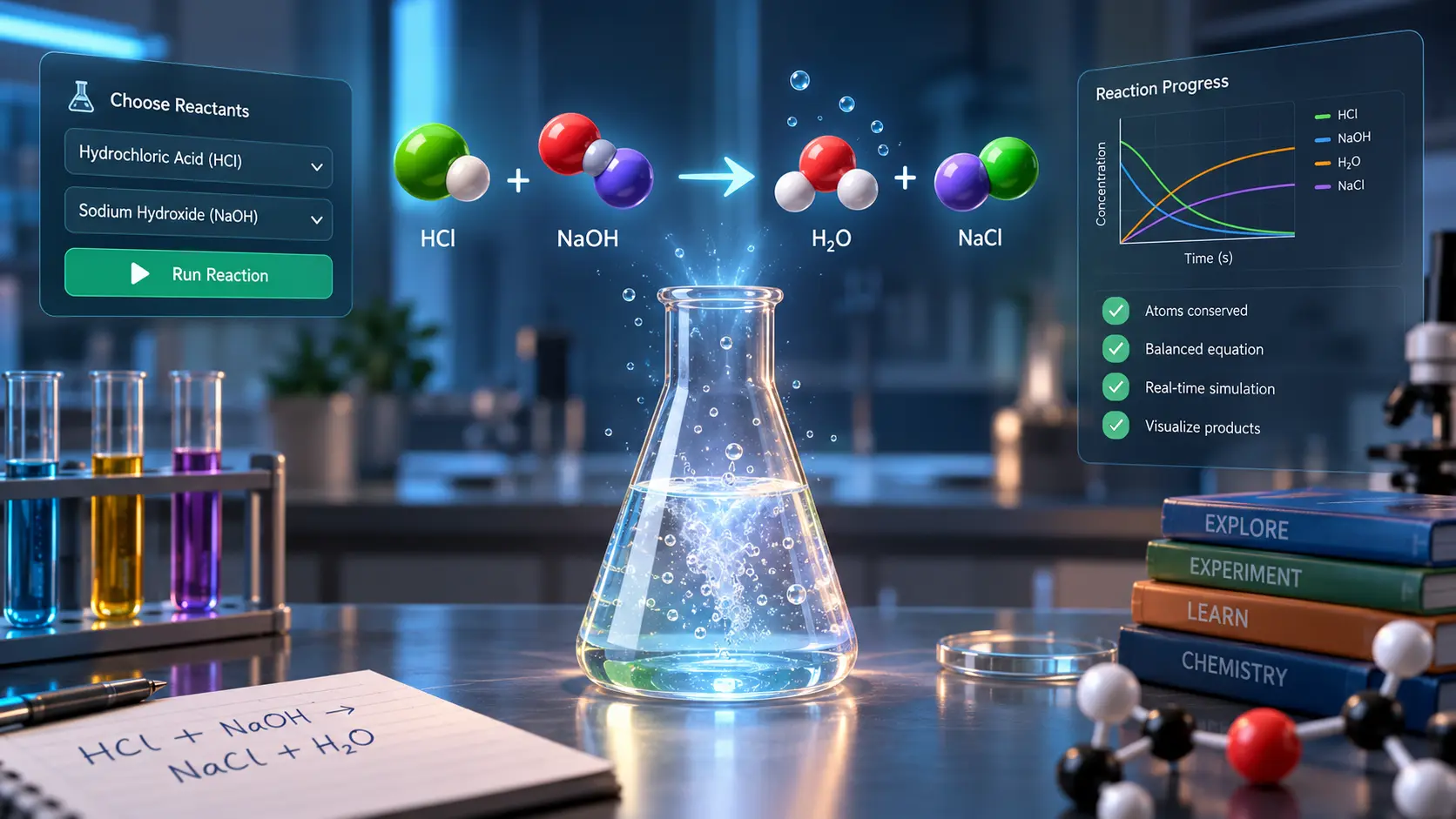
A chemical reaction simulator is a browser-based tool that lets you run virtual chemistry experiments — setting reactants, adjusting conditions like temperature, concentration, and pressure, and observing how the reaction proceeds and what products form.
The best simulators don't just show you the answer. They show you the process:
- How reactant molecules collide and rearrange into products
- How changing concentration affects reaction rate
- How temperature shifts equilibrium position
- How energy is absorbed or released during the reaction
- What happens when you add a catalyst
The key difference between reading about a reaction and simulating one is feedback. When you read that increasing temperature increases reaction rate, you accept it as a fact. When you increase temperature in a simulator and watch the reaction rate visibly accelerate, you understand why — and you won't forget it.
The Five Types of Chemical Reactions You Need to Understand
1. Synthesis Reactions
Two or more reactants combine to form a single product:
A + B → AB
Example: Iron reacting with sulfur to form iron sulfide
Fe + S → FeS
What to observe in simulation: Watch how two separate substances combine into one. Notice that the product has different properties from either reactant — iron is magnetic, sulfur is yellow, iron sulfide is neither.
Common exam question: Given reactants, identify the product and write the balanced equation.
2. Decomposition Reactions
A single compound breaks down into two or more simpler substances — the reverse of synthesis:
AB → A + B
Example: Hydrogen peroxide decomposing into water and oxygen
2H₂O₂ → 2H₂O + O₂
What to observe in simulation: Notice that decomposition often requires an input of energy — heat, light, or electricity. The activation energy barrier is visible in energy diagrams.
Real-world connection: This is why hydrogen peroxide is stored in dark bottles — light triggers decomposition.
3. Single Replacement Reactions
A more reactive element displaces a less reactive one from a compound:
A + BC → AC + B
Example: Zinc displacing copper from copper sulfate solution
Zn + CuSO₄ → ZnSO₄ + Cu
What to observe in simulation: The activity series determines which element displaces which. A more reactive metal will displace a less reactive one — but never the reverse. Watch the blue copper sulfate solution become colorless as zinc replaces copper.
Key concept: Reactivity is not arbitrary — it follows a predictable series. Understanding the activity series lets you predict whether a single replacement reaction will occur at all.
4. Double Replacement Reactions
Two compounds exchange ions to form two new compounds:
AB + CD → AD + CB
Example: Sodium chloride reacting with silver nitrate
NaCl + AgNO₃ → AgCl + NaNO₃
What to observe in simulation: Many double replacement reactions form a precipitate — an insoluble solid that falls out of solution. Silver chloride (AgCl) is a white precipitate. Watch it form as the ions combine.
Prediction tool: Solubility rules determine whether a precipitate forms. If both potential products are soluble, no visible reaction occurs. If one is insoluble, a precipitate forms.
5. Combustion Reactions
A substance reacts with oxygen to produce carbon dioxide and water (for complete combustion of hydrocarbons):
Hydrocarbon + O₂ → CO₂ + H₂O
Example: Methane burning
CH₄ + 2O₂ → CO₂ + 2H₂O
What to observe in simulation: Combustion is exothermic — it releases energy. The energy diagram shows products at lower energy than reactants. Watch what happens with incomplete combustion when oxygen supply is limited — carbon monoxide forms instead of carbon dioxide.
Real-world connection: Incomplete combustion in car engines and gas stoves produces carbon monoxide — an odourless, toxic gas. Complete combustion requires sufficient oxygen supply.
The Concepts That Click Instantly With Simulation
Activation Energy
Every reaction requires an initial input of energy to get started — even exothermic reactions that release energy overall. This is activation energy (Eₐ).
Reading about activation energy is abstract. Seeing it on an energy diagram — a hill the reactants must climb before rolling down to products — makes it immediately intuitive.
In simulation: The energy diagram shows activation energy as the peak between reactants and products. An exothermic reaction has products lower than reactants (energy released). An endothermic reaction has products higher (energy absorbed).
A catalyst lowers the activation energy peak — the reaction can proceed faster because fewer molecules need enough energy to overcome the barrier. Watch this happen in real time: add a catalyst, watch the activation energy drop, watch the reaction rate increase.
Le Chatelier's Principle
For reversible reactions at equilibrium, any change to the system causes the equilibrium to shift to oppose that change. This is Le Chatelier's Principle, and it's one of the most conceptually difficult topics in chemistry — until you see it.
N₂ + 3H₂ ⇌ 2NH₃ + heat
Increase concentration of N₂: Equilibrium shifts right — more NH₃ produced to use up the extra N₂.
Increase temperature: Equilibrium shifts left — the reaction absorbs heat to oppose the temperature increase, producing more N₂ and H₂.
Increase pressure: Equilibrium shifts right — fewer moles of gas on the right side (2 vs 4), so increasing pressure favours the side with fewer gas molecules.
In a simulator you can make each of these changes and watch the equilibrium position shift in real time. The concept that takes three paragraphs to explain takes ten seconds to understand visually.
Reaction Rate Factors
Four factors affect how fast a reaction proceeds:
Concentration — More reactant molecules per unit volume means more collisions per second, faster reaction. Double the concentration, roughly double the rate for a first-order reaction.
Temperature — Higher temperature means molecules move faster, collide more frequently, and with more energy. More collisions exceed the activation energy threshold. A 10°C rise approximately doubles the reaction rate for many reactions.
Surface area — More surface area exposed means more molecules available for collision. Powdered reactants react faster than lumps — same mass, more surface.
Catalyst — Provides an alternative reaction pathway with lower activation energy. More molecules can react per second without changing temperature or concentration.
In simulation: Change each factor independently and watch the reaction rate respond. This is the only way to truly understand that these factors work independently and additively.
Conservation of Mass
Atoms are rearranged in chemical reactions — never created or destroyed. The total mass of products equals the total mass of reactants. This is the Law of Conservation of Mass.
Reading it: fine. Seeing it in a 3D simulator where you watch atoms detach from reactant molecules and reattach to form products — without any atom appearing or disappearing — makes it unforgettable.
This is also why balancing equations is not an arbitrary rule. It's a mathematical expression of conservation of mass — the number of each type of atom must be the same on both sides.
How to Use the OpenLabs Chemical Reaction Simulator
The OpenLabs Reaction Simulator lets you build and run chemical reactions in 3D with real-time dynamics and post-processing effects.
Here's the approach that builds genuine understanding:
Start with a preset reaction Load one of the preset reactions — a synthesis, decomposition, or combustion reaction. Watch it run at default conditions. Note what the reactants look like, what the products look like, and how the energy diagram behaves.
Change one condition at a time Increase temperature and watch the reaction rate change. Reset, then increase concentration. Reset, then add a catalyst. Changing one variable at a time lets you see exactly what each factor does — the scientific method applied to your own study.
Try to predict before you run Before changing a condition, predict what will happen. Will the reaction rate increase or decrease? Will the equilibrium shift left or right? Run the simulation and check your prediction. Correct predictions build confidence. Wrong predictions reveal gaps — which is even more valuable.
Use the daily challenge The daily challenge in the reaction simulator gives you a specific outcome to achieve by adjusting conditions. This bridges the gap between qualitative understanding and quantitative application — exactly what exam questions test.
OpenLabs Chemical Reaction Simulator
Balancing Chemical Equations — The Right Way to Think About It
Most students learn to balance equations by trial and error — adjust coefficients until the numbers match on both sides. This works but doesn't build understanding.
The right way to think about balancing is through conservation of mass. Every atom present in the reactants must appear in the products. Coefficients tell you how many molecules of each substance are involved — they scale the entire molecule, not individual atoms.
A systematic approach:
- Write the unbalanced equation
- Count atoms of each element on each side
- Start with the most complex molecule — balance it first
- Balance metals next, then non-metals, then hydrogen, then oxygen last
- Check that all atoms balance
- Verify the equation is in its simplest form (coefficients reduced to lowest whole numbers)
Example: Balance the combustion of propane
C₃H₈ + O₂ → CO₂ + H₂O (unbalanced)
Carbon: 3 on left, 1 on right → need 3CO₂
C₃H₈ + O₂ → 3CO₂ + H₂O
Hydrogen: 8 on left, 2 on right → need 4H₂O
C₃H₈ + O₂ → 3CO₂ + 4H₂O
Oxygen: 10 on right (6 + 4), 2 on left → need 5O₂
C₃H₈ + 5O₂ → 3CO₂ + 4H₂O ✓
Check: C: 3=3 ✓, H: 8=8 ✓, O: 10=10 ✓
In simulation: After balancing, run the reaction and watch 1 propane molecule react with 5 oxygen molecules to produce exactly 3 carbon dioxide and 4 water molecules. Conservation of mass, made visible.
Endothermic vs Exothermic — Getting It Right
This is one of the most commonly confused pairs in chemistry.
Exothermic reactions release energy to surroundings. Products have less energy than reactants. The energy diagram shows a downhill profile. The surroundings get warmer.
Examples: Combustion, neutralisation reactions, most single replacement reactions
Energy diagram: Reactants ——Eₐ—— ↘ Products (lower energy)
Endothermic reactions absorb energy from surroundings. Products have more energy than reactants. The energy diagram shows an uphill profile. The surroundings get cooler.
Examples: Photosynthesis, thermal decomposition, dissolving ammonium nitrate in water
Energy diagram: Products (higher energy) ↗ Reactants ——Eₐ——
The common misconception: Students think exothermic means the reaction requires heat to start. It doesn't — it requires activation energy to start, then releases more energy than it absorbed overall. Striking a match is exothermic — you need the initial friction to start it, then it releases heat as it burns.
In simulation: The energy diagram shows both activation energy (the initial barrier) and the overall energy change (exothermic or endothermic). Watch the difference between the two — activation energy is always required, but the overall energy balance determines whether heat is released or absorbed.
Stoichiometry — Making the Numbers Make Sense
Stoichiometry is the quantitative relationship between reactants and products in a chemical reaction. It's based entirely on the balanced equation — the mole ratios tell you exactly how much of each substance is involved.
The mole ratio method:
From: CH₄ + 2O₂ → CO₂ + 2H₂O
If you burn 4 moles of CH₄:
- You need 4 × 2 = 8 moles of O₂
- You produce 4 moles of CO₂
- You produce 4 × 2 = 8 moles of H₂O
The mole ratios from the balanced equation (1:2:1:2) scale to any amount.
Limiting reagent:
If you have 4 moles CH₄ but only 6 moles O₂ (not the required 8):
- O₂ is the limiting reagent — it runs out first
- Only 3 moles of CH₄ can react (6 moles O₂ ÷ 2 = 3 moles CH₄)
- 1 mole of CH₄ remains unreacted (excess reagent)
- Products: 3 moles CO₂ and 6 moles H₂O
In simulation: Set a limiting reagent scenario — give less of one reactant than stoichiometry requires. Watch the reaction stop when the limiting reagent is consumed, with excess reactant remaining visible.
Common Exam Mistakes in Chemical Reactions
Confusing endothermic and exothermic based on activation energy. Activation energy is always required to start a reaction — it doesn't determine whether the reaction is endothermic or exothermic. That's determined by whether the overall energy of products is higher or lower than reactants.
Forgetting state symbols. (s) solid, (l) liquid, (g) gas, (aq) aqueous. Examiners specifically mark these in many syllabuses.
Changing subscripts instead of coefficients when balancing. Changing a subscript changes the substance entirely (H₂O becomes H₂O₂). Only coefficients can be changed when balancing — they scale the molecule, not change it.
Misidentifying reaction types. The most reliable approach: look at the number of reactants and products and whether elements are swapped between compounds. One reactant → decomposition impossible. Two elements combining → synthesis. Element + compound → single replacement.
Ignoring the activity series for single replacement. Not all single replacement reactions occur. A less reactive metal cannot displace a more reactive one. Always check the activity series before predicting whether a reaction proceeds.
Getting limiting reagent wrong. The limiting reagent is not always the one present in smaller amount. It's the one that runs out first based on stoichiometric ratios. Calculate moles needed for each reagent and compare to what's available.
Why Simulation Beats Passive Study for Chemistry
Chemistry is fundamentally an experimental science. The historical knowledge of chemistry was built through observation — chemists ran experiments, observed outcomes, formed hypotheses, and tested them.
Studying chemistry only through textbooks strips away everything that makes the subject make sense. You're left with rules that seem arbitrary because you've never seen the phenomena they describe.
Educational simulators change the role of the student from a mere recipient of information to the main player in the construction of their own knowledge. That's not a pedagogical abstraction — it's the practical reality of how understanding forms. You remember what you've done far better than what you've read.
A reaction simulator lets you be a chemist — forming hypotheses, testing conditions, observing results. The understanding you build is yours in a way that memorized notes never are.
Run chemical reactions in the OpenLabs Chemistry Lab — free, browser-based, no download required.
Stuck on a specific reaction type or concept? The AI assistant inside the lab understands which experiment you have open and can walk you through the chemistry in real time.