Newton's Laws of Motion are everywhere in physics education. They're on every syllabus, tested in every exam, and recited by millions of students who can state them perfectly and still can't use them correctly.
"An object at rest stays at rest." Fine. But what does that actually mean when you're solving a problem? Why does a heavier object not fall faster? Why do you feel pushed back in a car seat when it accelerates?
The laws aren't hard. The way they're usually taught is. This guide covers what each law actually means, the misconceptions that turn easy marks into lost marks, and how seeing them in action changes everything.
Newton's First Law — Inertia
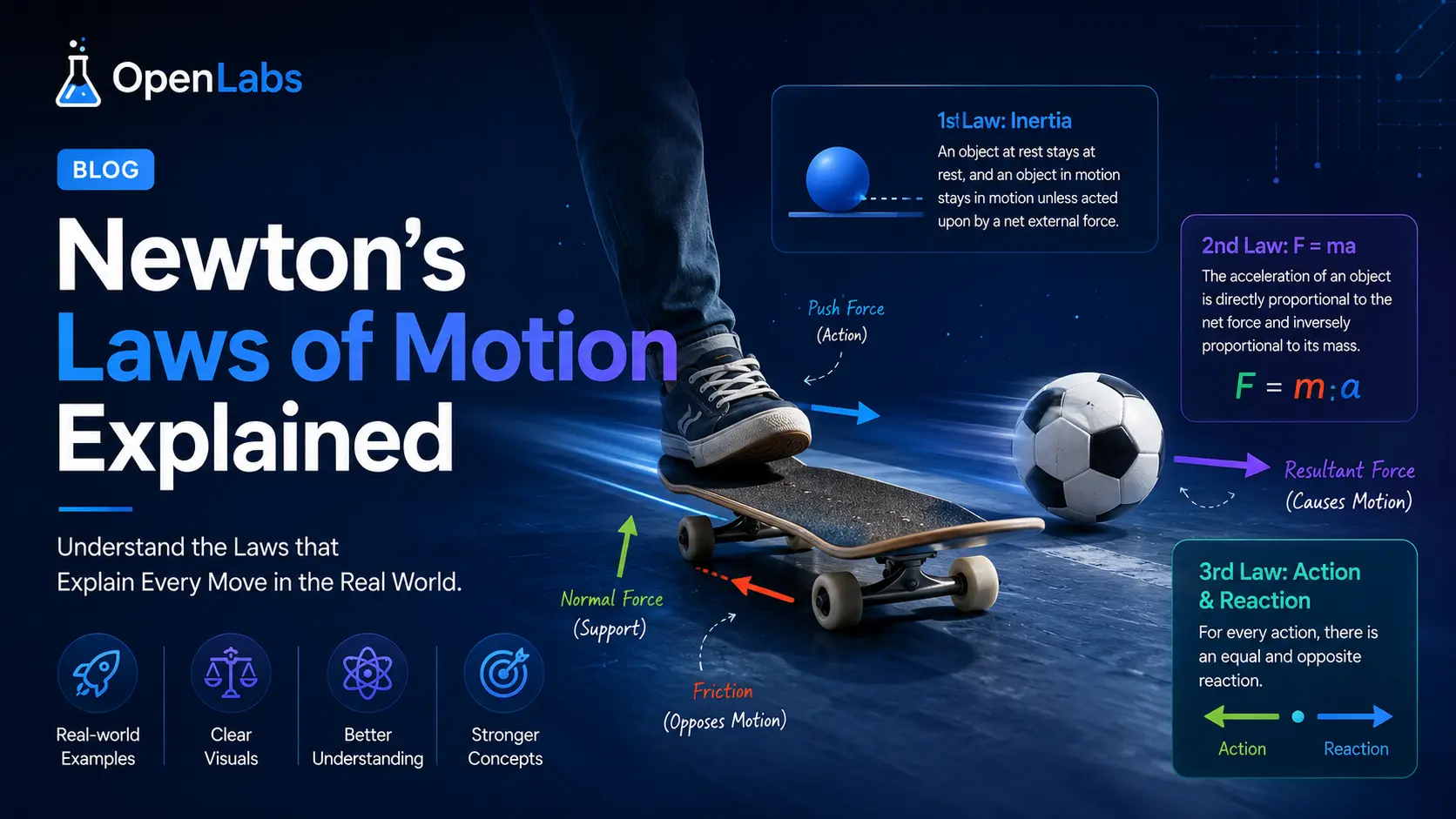
The statement: An object at rest stays at rest, and an object in motion stays in motion at constant velocity, unless acted on by a net external force.
What it actually means:
Objects don't change their motion on their own. Change requires a force. Without a force, whatever an object is doing — sitting still or moving — it keeps doing forever.
This seems obvious for objects at rest. Of course a book on a table doesn't move by itself. But the second part trips students up constantly.
An object moving at constant velocity needs no force to keep moving. It will keep moving forever without any force applied. The reason things slow down on Earth isn't because motion naturally fades — it's because friction is a force that opposes motion.
In space, away from gravity and air resistance, a spacecraft that turns off its engines keeps moving at the same speed in the same direction indefinitely. That's Newton's First Law in its purest form.
The misconception it creates:
Students consistently think that a moving object requires a constant force to keep moving. They say things like "the force carrying the ball forward" after it's thrown. There is no such force. Once the ball leaves your hand, the only forces acting on it are gravity (downward) and air resistance (opposing motion). The ball's continued motion is inertia — not a force.
How to see it:
In the Free Fall lab, the moment the ball is released, no force is propelling it forward or downward — gravity pulls it down, but there's nothing "giving it speed." The initial velocity is just whatever state it started in, maintained by inertia until gravity changes it.
Newton's Second Law — F = ma
The statement: The acceleration of an object is directly proportional to the net force acting on it and inversely proportional to its mass.
What it actually means:
More force → more acceleration. More mass → less acceleration for the same force. These relationships are linear and exact.
This is the law you use to calculate. Every time you solve a physics problem involving motion, forces, or acceleration, you're applying F = ma.
The critical word is net force. F in F = ma is not any single force — it's the vector sum of all forces acting on the object. If you push a box with 10N and friction pushes back with 4N, the net force is 6N and that's what you use to calculate acceleration.
The misconceptions it creates:
"Heavier objects fall faster." This is the most persistent misconception in all of physics, predating Newton by centuries. In free fall, the only force is gravity: F = mg. So a = F/m = mg/m = g. The mass cancels. Every object falls at the same acceleration (9.8 m/s²) regardless of mass, because heavier objects have proportionally more gravitational force pulling them — exactly enough to compensate for their greater inertia.
"Force causes velocity, not acceleration." F = ma means force causes acceleration — change in velocity — not velocity itself. A constant force produces constant acceleration, which means continuously increasing velocity. A net force of zero means zero acceleration — constant velocity, not zero velocity.
How to see it:
In the Projectile Motion lab, change the mass of the projectile. The trajectory doesn't change — because mass cancels out in free fall. Then look at horizontal motion — no net horizontal force means no horizontal acceleration, so horizontal velocity stays constant throughout the flight.
OpenLabs Projectile Motion Lab
Newton's Third Law — Action and Reaction
The statement: For every action, there is an equal and opposite reaction.
What it actually means:
Forces always come in pairs. When object A exerts a force on object B, object B exerts an equal and opposite force on object A. Always. Without exception.
The forces are equal in magnitude and opposite in direction — but they act on different objects. This is the part students miss.
The misconceptions it creates:
"If forces are equal and opposite, they cancel out." They don't — because they act on different objects. When you push a wall, the wall pushes back on you with equal force. Your force acts on the wall; the wall's force acts on you. They can't cancel because they're on different objects.
"The heavier object exerts more force." No. A truck and a bicycle in a collision exert exactly equal forces on each other. The difference in damage is due to Newton's Second Law — the bicycle has much less mass, so the same force produces much more acceleration (deceleration in this case).
"Reaction forces happen after action forces." They happen simultaneously. There's no time delay between action and reaction. The moment you push, the push-back exists.
How to see it:
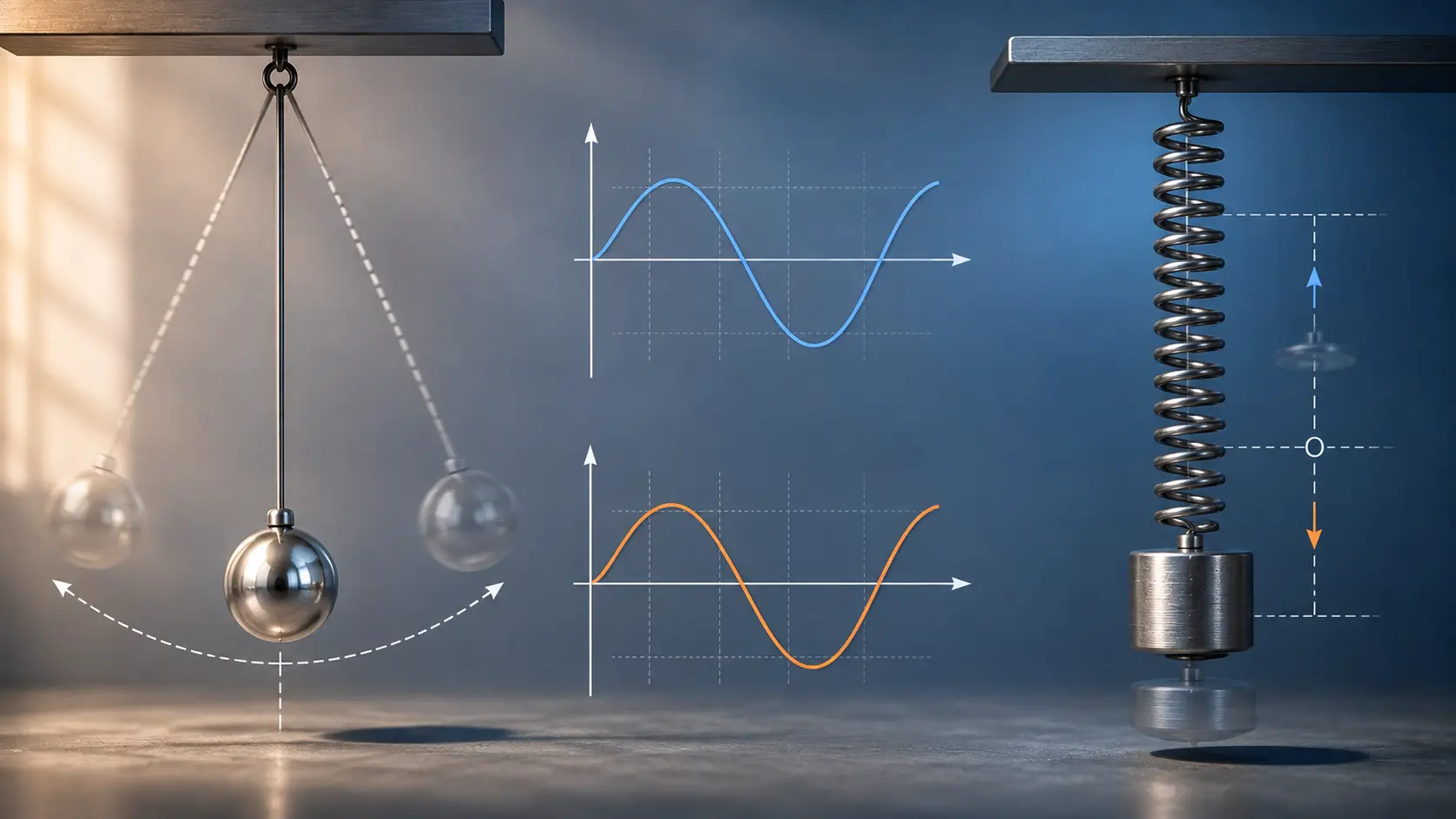
In the Hooke's Law lab, the spring exerts a force on the mass equal and opposite to the weight of the mass pulling down. The spring stretches until these forces balance. This equilibrium is Newton's Third Law and Newton's First Law working together — the net force on the mass is zero, so it doesn't accelerate.
How the Three Laws Work Together
The laws aren't separate topics — they describe one unified picture of motion.
First Law tells you when acceleration is zero: when net force is zero. Second Law tells you how much acceleration results from a given net force. Third Law tells you that forces always come in pairs on different objects.
A worked example that uses all three:
A 2kg box sits on a table. You push it horizontally with 10N. Friction exerts 4N opposing the push. Find the acceleration.
- Third Law: the table pushes up on the box with equal and opposite force to the box's weight — they're on different objects so don't cancel each other.
- First Law: vertical net force is zero (weight down = normal force up), so no vertical acceleration.
- Second Law: net horizontal force = 10 - 4 = 6N. a = F/m = 6/2 = 3 m/s².
All three laws, one problem.
The Study Approach That Actually Works
Don't memorize the statements — understand the consequences.
For each law, ask: what would the world look like if this law weren't true? If First Law were false, objects would spontaneously slow down in empty space. If Second Law were false, heavier objects would fall faster. If Third Law were false, you could push a wall without it pushing back.
The laws feel obvious once you understand them because they describe reality. The goal isn't to memorize words — it's to build a mental model of how forces and motion work.
Use the simulations before the problems.
Before doing any calculation involving Newton's Laws, spend 10-15 minutes in the relevant lab. Watch objects fall, projectiles arc, springs stretch. Let your brain form the spatial intuition first. Then the formulas express what you already understand rather than rules you're trying to remember.
The daily challenges in each lab give you specific targets to hit — a specific acceleration to achieve, a specific range to land in — which forces you to apply the laws quantitatively, not just qualitatively. That's the bridge between intuition and exam performance.
Common Exam Mistakes
Forgetting that F is net force. Always add up all forces as vectors before applying F = ma.
Treating Newton's Third Law pairs as forces on the same object. Action-reaction pairs always act on different objects. If they're on the same object, they're not a Newton's Third Law pair.
Assuming a stationary object has no forces acting on it. A book on a table has two forces acting on it — gravity down and normal force up. They're equal and opposite (Newton's First Law — zero net force, zero acceleration) but they're not a Newton's Third Law pair because they act on the same object.
Confusing weight and mass. Mass is measured in kilograms. Weight is a force measured in Newtons. W = mg. A 5kg object has a weight of 49N on Earth.
Stuck on a specific Newton's Law problem? The AI assistant inside any physics lab can walk you through it in the context of the experiment you have open.