Theory and background
What is free fall?
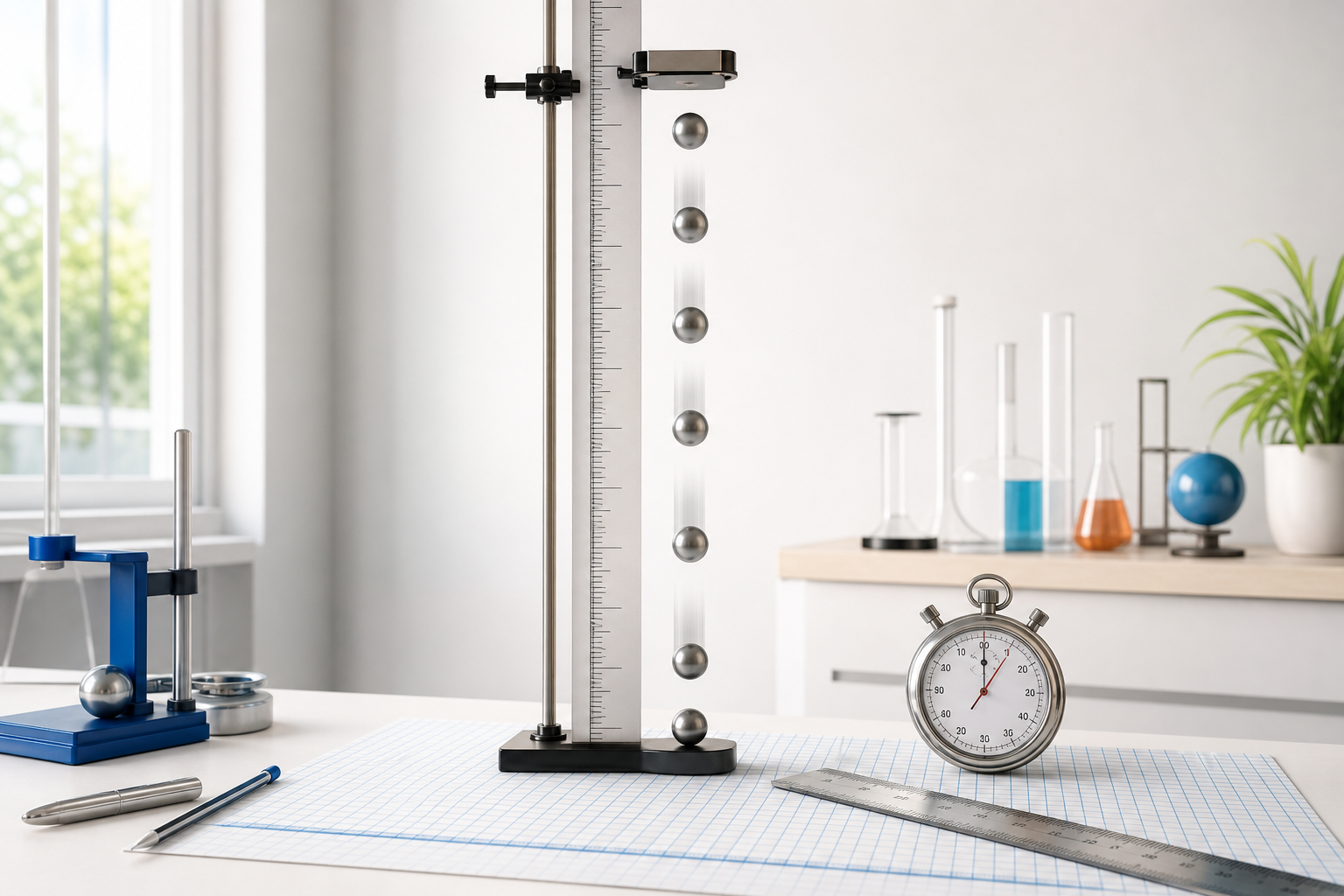
Free fall is motion under the influence of gravity alone. In the ideal model, all objects near Earth's surface accelerate downward at the same rate when air resistance is ignored.
Explore vertical motion under gravity. Drop an object, measure how velocity changes with time, and connect the motion with constant acceleration.

Experiment guide
Start with the concept, open the lab, then compare the observed motion with the key relationship. The sections below keep the theory, workflow, and common questions easy to scan.
Theory and background
Free fall is motion under the influence of gravity alone. In the ideal model, all objects near Earth's surface accelerate downward at the same rate when air resistance is ignored.
How the simulation works
Launch the lab, adjust the available controls, and observe the result immediately. Use the simulation to connect the equation with what changes on screen.
Frequently asked questions
Free fall is motion where gravity is the only significant force acting on an object.
Ignoring air resistance, all objects fall with the same acceleration regardless of mass.
Near Earth's surface, gravitational acceleration is about 9.81 m/s^2 downward.
Air resistance opposes motion and can reduce acceleration, especially for light or broad objects.