ChemistryInteractive SimulatorZero Install100% Free

ReactionKinetics&Equilibrium

Explore reaction kinetics and dynamic equilibrium in real time. Adjust reactant concentrations, thermal temperatures, and catalytic surfaces to observe molecular collision frequencies, transition states, and yield dynamics.

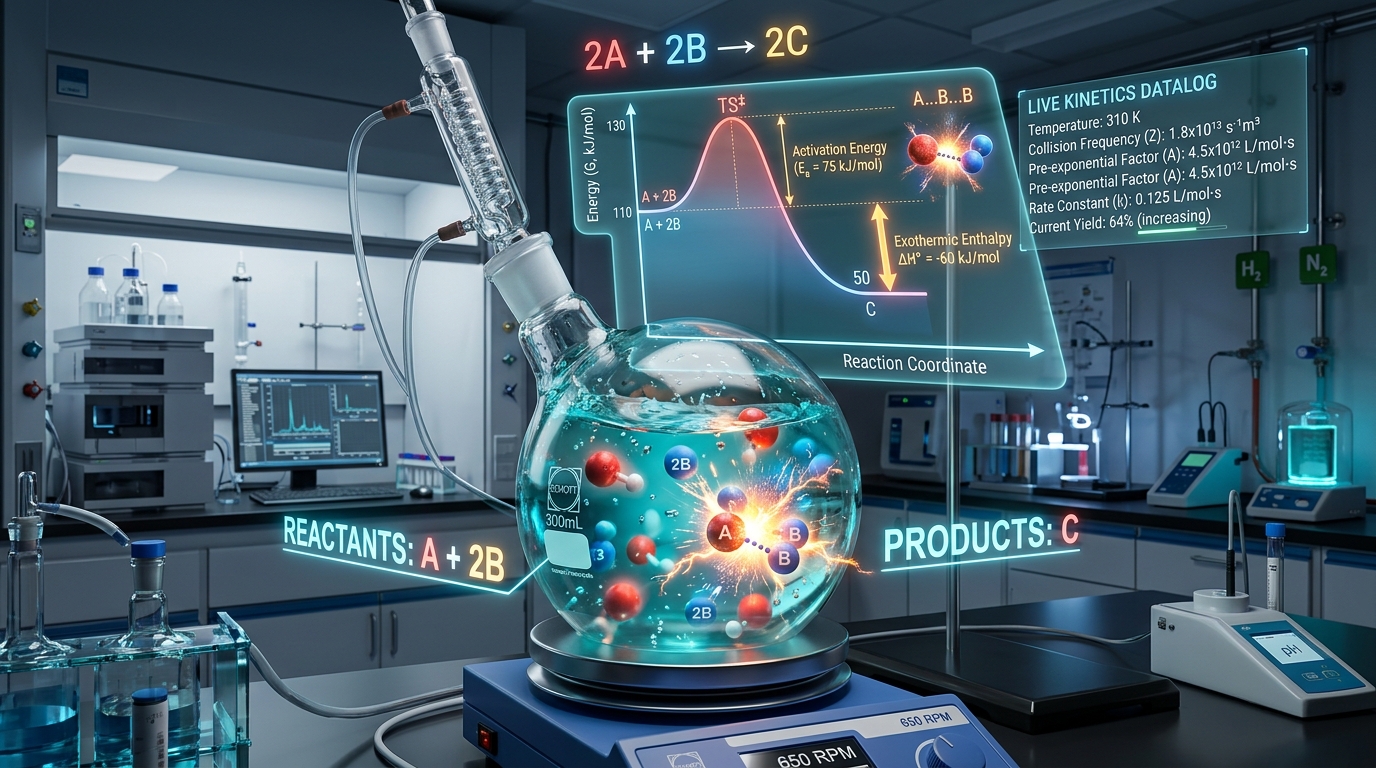
Reaction Kinetics & Equilibrium interactive Chemistry simulation illustration
Molecular Collision & Reaction Coordinate BenchArrhenius Potential Energy Profile • Dynamic Yield Meter • Catalytic Energy Reduction

Interactive Experiment Guide

Use this studio like a real-time chemistry workbench

Start with fundamental scientific principles, launch the simulation, and verify mathematical predictions against real-time outcomes.

DisciplineChemistry
Simulation ModeInteractive Numeric Engine
Governing ModelMolecular Collision & Reaction Coordinate Bench
DeploymentIn-Browser WebAssembly / GPU
01

Scientific Foundation

What is reaction kinetics & equilibrium?

Chemical reactions proceed according to collision theory: reactant molecules must collide with sufficient kinetic energy exceeding the activation energy barrier (E_a) and in the proper stereochemical orientation. The temperature dependence of the rate constant is modeled by the Arrhenius equation (k = A e^(-E_a/RT)). In reversible systems, dynamic equilibrium is reached when forward and reverse reaction rates become equal, governed by the equilibrium constant K_c.

02

Interactive Simulation Flow

Experiment Execution & Governing Equations

Launch the simulation workspace, adjust parameters in real time, and observe the immediate response in the telemetry and graphical indicator loops.

Arrhenius Rate Equation & Chemical Equilibrium Lawk = A e^{-\frac{E_a}{RT}} \quad \text{and} \quad \text{Rate} = k [A]^m [B]^n \quad \text{and} \quad K_c = \frac{[C]^c [D]^d}{[A]^a [B]^b}

Frequently Asked Questions

Reaction Kinetics & Equilibrium FAQ

3 Answers

A catalyst provides an alternative reaction pathway with a lower activation energy barrier (E_a). Because the exponential term e^(-E_a/RT) in the Arrhenius equation becomes significantly larger, a greater fraction of colliding molecules possess sufficient energy to react, increasing the reaction rate without consuming the catalyst.

Knowledge Graph & Related Concepts