ChemistryInteractive SimulatorZero Install100% Free

ElectronicConfiguration&QuantumOrbitals

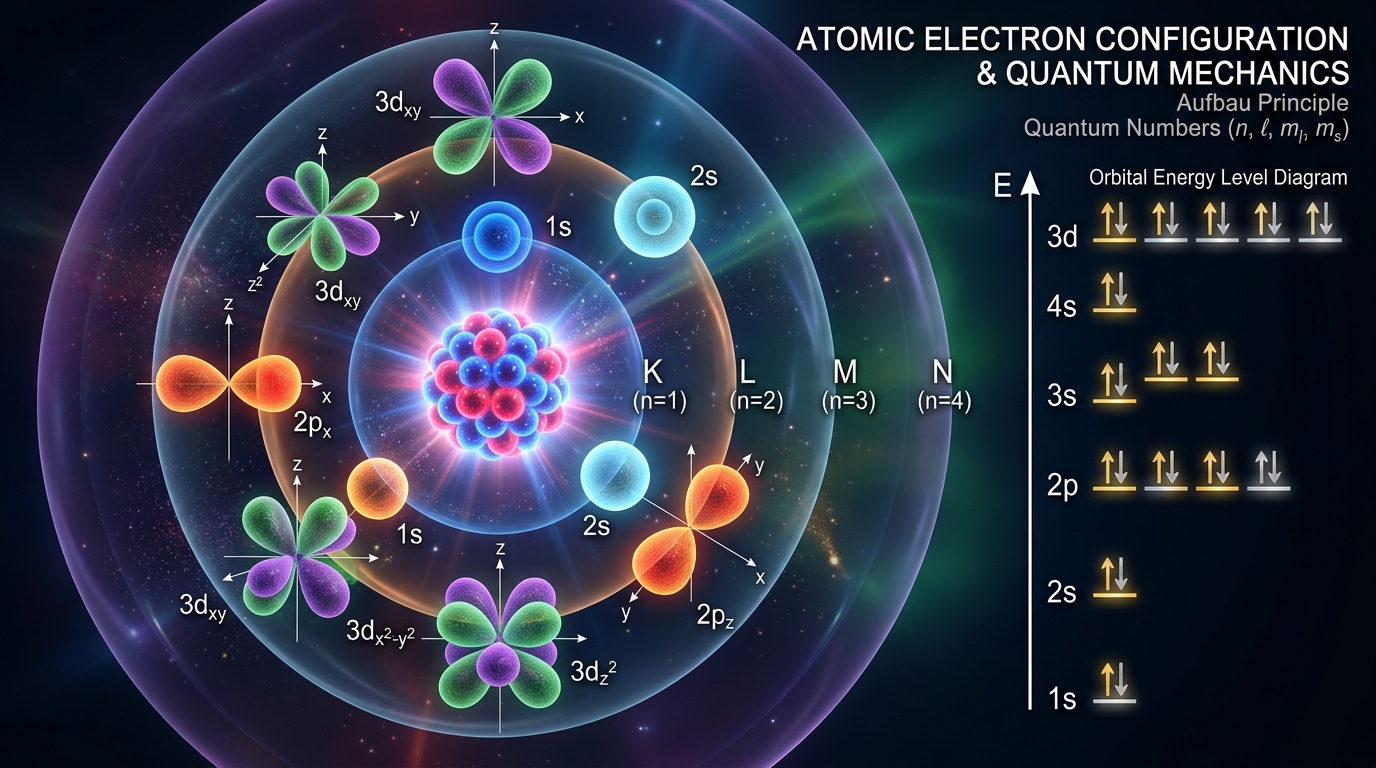
Visualize atomic electron subshell filling from Hydrogen (Z = 1) to Oganesson (Z = 118). Inspect quantum numbers (n, l, m_l, m_s), build orbital energy level diagrams, and observe anomalous electron configurations in transition metals.

Electronic Configuration & Quantum Orbitals interactive Chemistry simulation illustration
Quantum Orbital Energy Ladder & 3D Probability DensityAufbau Energy Fill Engine • Spin Up / Down Arrows • Transition Metal Anomalies (Cr, Cu)

Interactive Experiment Guide

Use this studio like a real-time chemistry workbench

Start with fundamental scientific principles, launch the simulation, and verify mathematical predictions against real-time outcomes.

DisciplineChemistry
Simulation ModeInteractive Numeric Engine
Governing ModelQuantum Orbital Energy Ladder & 3D Probability Density
DeploymentIn-Browser WebAssembly / GPU
01

Scientific Foundation

What is electronic configuration & quantum orbitals?

The electronic configuration of an atom describes the spatial and energetic distribution of its electrons across quantized energy levels. Electron filling follows three fundamental quantum mechanics principles: (1) The Aufbau Principle (electrons occupy lowest energy orbitals first, following the (n + l) Madelung rule), (2) Pauli Exclusion Principle (no two electrons in an atom can have identical sets of four quantum numbers, limiting each orbital to two opposite-spin electrons), and (3) Hund's Rule of Maximum Multiplicity (degenerate orbitals are filled singly with parallel spins before pairing occurs).

02

Interactive Simulation Flow

Experiment Execution & Governing Equations

Launch the simulation workspace, adjust parameters in real time, and observe the immediate response in the telemetry and graphical indicator loops.

Bohr Energy Levels & Madelung Aufbau RuleE_n = -\frac{13.6 \, Z^2}{n^2} \text{ eV} \quad \text{and} \quad \text{Madelung Rule: Lower } (n + \ell) \text{ fills first}

Frequently Asked Questions

Electronic Configuration & Quantum Orbitals FAQ

3 Answers

The four quantum numbers are: (1) Principal quantum number (n = 1, 2, 3...) determining the main energy level and shell size, (2) Angular momentum quantum number (l = 0 to n-1) defining orbital shape (s, p, d, f), (3) Magnetic quantum number (m_l = -l to +l) specifying orbital 3D spatial orientation, and (4) Spin quantum number (m_s = +1/2 or -1/2) defining intrinsic electron angular momentum.

Knowledge Graph & Related Concepts