ChemistryInteractive SimulatorZero Install100% Free

PeriodicTableofElements

Explore the foundation of chemistry with an interactive periodic table. Inspect element properties, color-code by electronegativity and ionization energy heatmaps, and visualize subshell orbital configurations in real time.

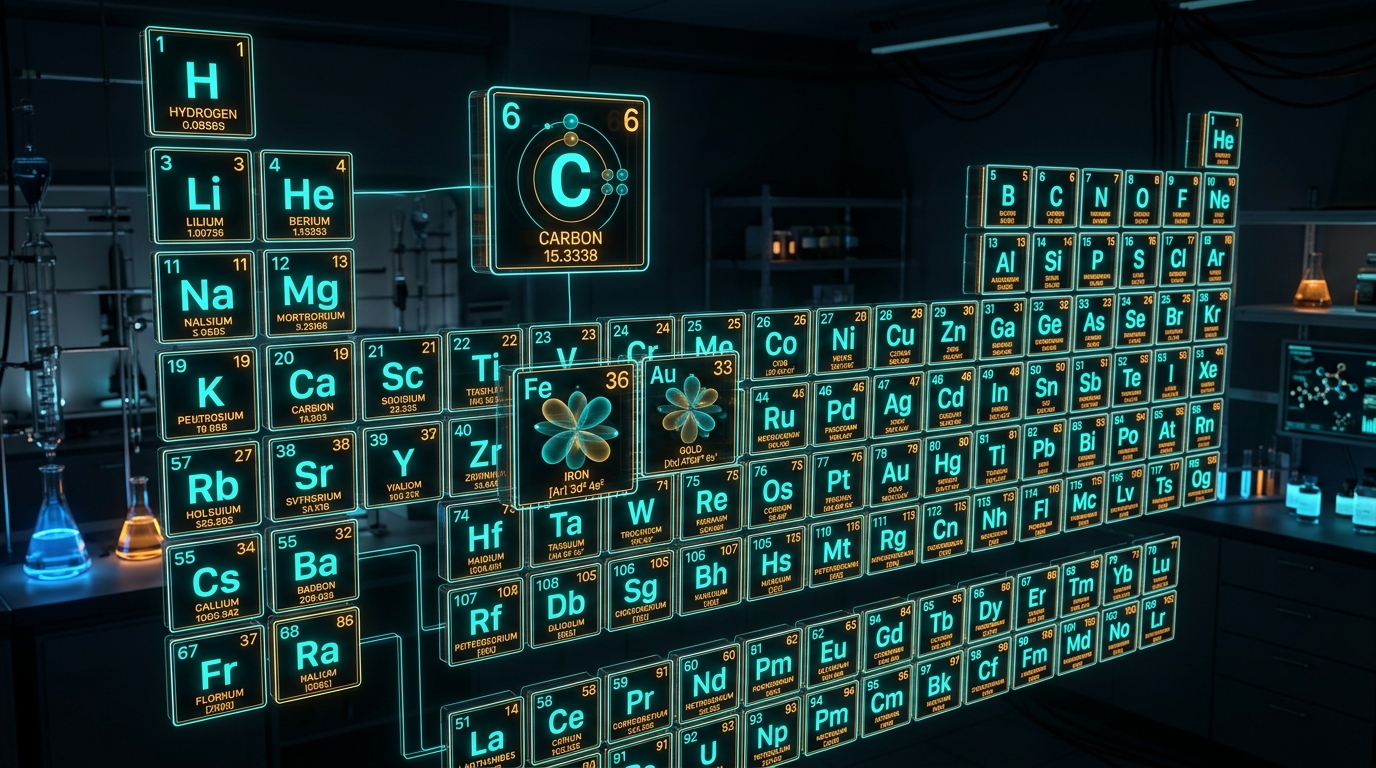
Periodic Table of Elements interactive Chemistry simulation illustration
Interactive 118-Element MatrixProperty Heatmaps • Subshell Blocks (s, p, d, f) • 3D Electron Shells

Interactive Experiment Guide

Use this studio like a real-time chemistry workbench

Start with fundamental scientific principles, launch the simulation, and verify mathematical predictions against real-time outcomes.

DisciplineChemistry
Simulation ModeInteractive Numeric Engine
Governing ModelInteractive 118-Element Matrix
DeploymentIn-Browser WebAssembly / GPU
01

Scientific Foundation

What is periodic table of elements?

The periodic table organizes all 118 confirmed chemical elements in order of increasing atomic number (Z, the number of protons). Periodic law dictates that elements with similar electron configurations exhibit recurring physical and chemical trends. As effective nuclear charge (Z_eff = Z - S) increases across periods, atomic radii contract while first ionization energy and electronegativity generally increase.

02

Interactive Simulation Flow

Experiment Execution & Governing Equations

Launch the simulation workspace, adjust parameters in real time, and observe the immediate response in the telemetry and graphical indicator loops.

Effective Nuclear Charge & Mulliken ElectronegativityZ_{\text{eff}} = Z - S \quad \text{and} \quad \chi = \frac{IE + EA}{2}

Frequently Asked Questions

Periodic Table of Elements FAQ

3 Answers

The table arranges elements by ascending atomic number into 7 horizontal rows ('periods') and 18 vertical columns ('groups'). Groups contain elements with identical valence electron configurations, leading to shared chemical reactivity.

Knowledge Graph & Related Concepts