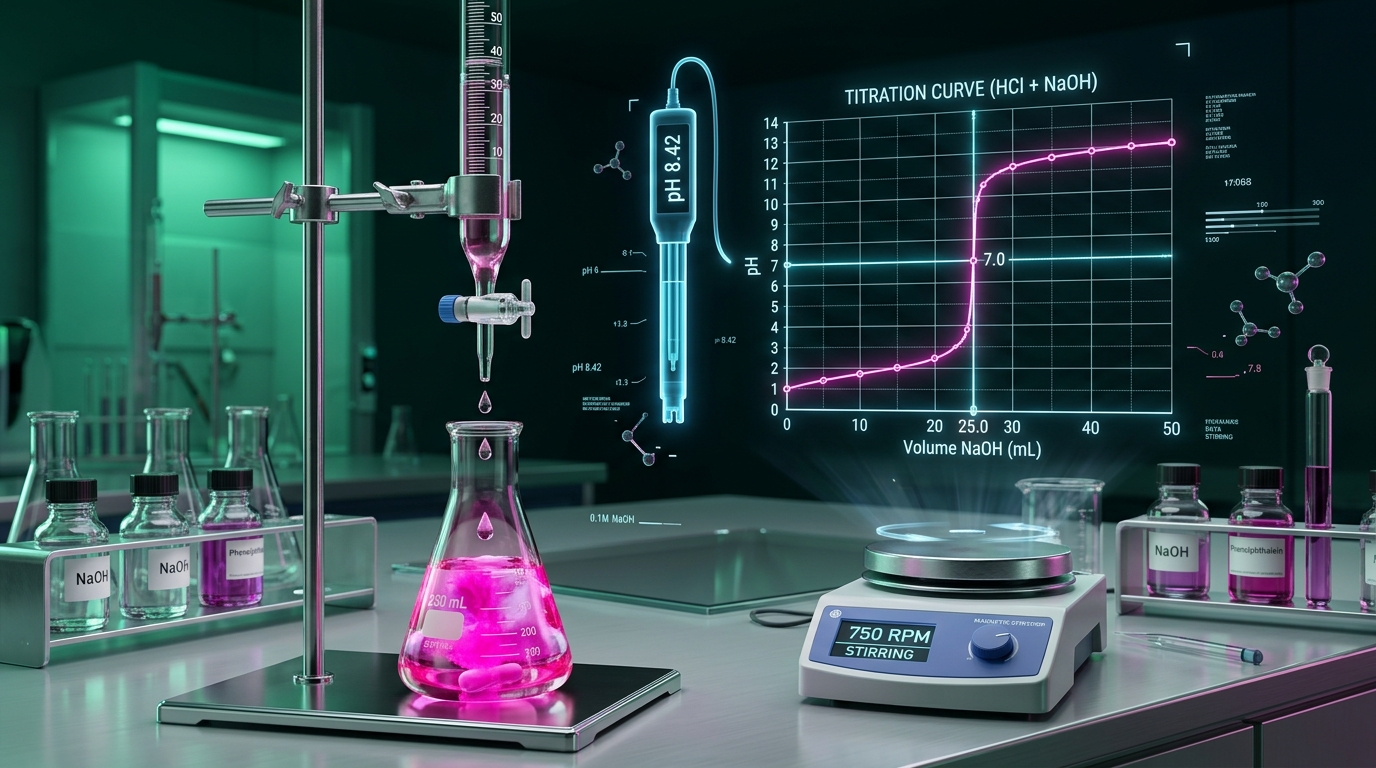
Titration Analysis Sandbox
Master volumetric analysis in a risk-free virtual environment. Control burette flow drop-by-drop, observe indicator color changes, and plot live pH curves to determine unknown concentrations.
Target Objectives
- Model 3D electron shell fields.
- Measure electronegativity deltas.
- Solve valency lattice challenges.
Theory & Core Foundations
Titration is a fundamental analytical chemistry technique used to determine the unknown concentration of an identified analyte (a substance being analyzed). A reagent, termed the titrant, is prepared as a standard solution of known concentration and volume.
The titrant is reacted with a solution of analyte to determine the analyte's concentration. The volume of titrant reacted is called the titration volume. For acid-base titrations, a pH indicator (like phenolphthalein or methyl orange) is often used to detect the endpoint—the point at which the color changes, which closely approximates the equivalence point.
The equivalence point is the ideal point in the titration where the amount of titrant added is stoichiometrically equal to the amount of analyte present in the sample.
Mathematical Foundations
The core principle of titration is stoichiometry. At the equivalence point, the moles of acid equal the moles of base. For weak acids, the buffer region is governed by the Henderson-Hasselbalch equation.
How The Simulation Works
Select your reagents and parameters. Use the titration controls to slowly add titrant from the burette into the analyte flask. Watch the live pH curve update in real-time. Stop adding titrant as soon as you observe a permanent color change from the indicator.
Frequently Asked Questions
Learning Objectives
- •Identify the equivalence point using pH curves and indicators.
- •Calculate unknown concentrations using C₁V₁ = C₂V₂.
- •Differentiate between strong/strong and weak/strong acid-base titration curves.
- •Understand the role of the half-equivalence point in weak acid titrations (pH = pKa).
Real World Applications
- ✓Water quality testing (alkalinity and hardness).
- ✓Food industry (determining acidity in wine and cheese).
- ✓Pharmaceuticals (quality control of drug concentrations).
- ✓Medical diagnostics (blood and urine analysis).