Reactivity & Chemical Bonding
Chemical Behavior & Oxidation States
Neon exhibits chemical reactivity characteristic of the noble gas family, governed by an electronegativity of n/a and standard valence interactions.
Ne
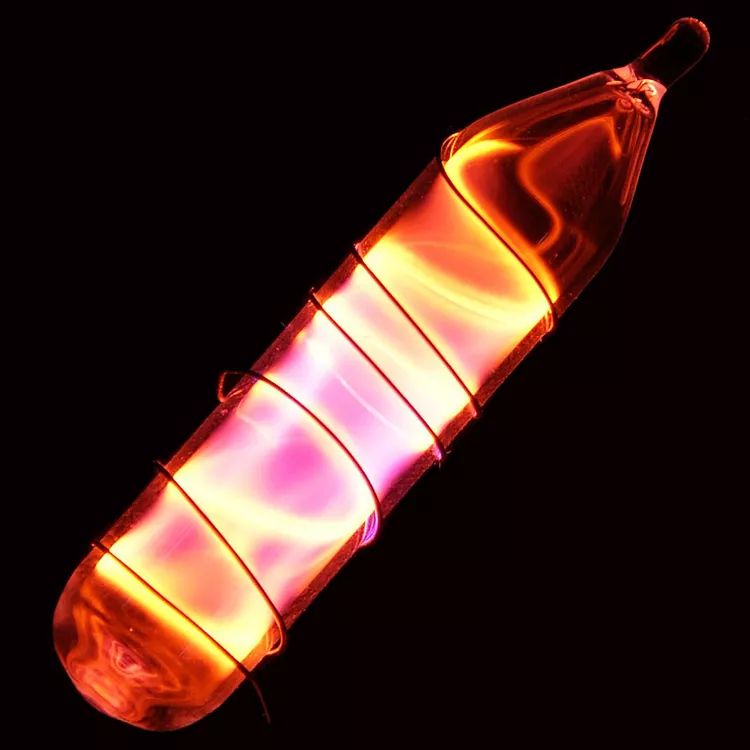
Neon (Ne) is an element with atomic number 10, classified as a noble gas. Positioned in Period 2, Group 18, and P-block, its chemical and physical profile is defined by its electron configuration ([He]2s²2p⁶) and periodic trends.
Simulate concentric quantum energy levels, observe valence electron spins, and examine live atomic clouds in full 3D.
Experiment with Aufbau subshell ordering, explore orbital occupancy, and analyze quantum configuration exceptions.
Neon exhibits chemical reactivity characteristic of the noble gas family, governed by an electronegativity of n/a and standard valence interactions.
Neon is utilized in industrial fabrication, materials engineering, electronic manufacturing, and advanced laboratory research based on its specific thermodynamic properties.
Neon does not play a prominent biological role in human biochemistry, existing primarily as a trace element or mineral component in natural ecosystems.
Elements like Neon are synthesized through stellar nucleosynthesis and supernovae r-processes. On Earth, Neon is concentrated in specific ore deposits or synthesized in nuclear accelerators.
Neon (Ne) has an atomic number of 10 and a standard atomic mass of 20.18 u. It is positioned in Period 2, Group 18, in the P-block, and is classified within the Noble Gas category.
The ground-state electron configuration of Neon is [He]2s²2p⁶. Its 10 electrons are distributed across 2 principal energy levels (2, 8).
Neon follows standard Aufbau principle orbital filling. Transition metals and heavy elements optimize their shell filling based on subshell exchange energy and electrostatic stability.
Neon is utilized in industrial fabrication, materials engineering, electronic manufacturing, and advanced laboratory research based on its specific thermodynamic properties.