Reactivity & Chemical Bonding
Chemical Behavior & Oxidation States
Chromium passivates spontaneously in air by forming an ultra-thin, impermeable layer of Cr₂O₃.
Cr
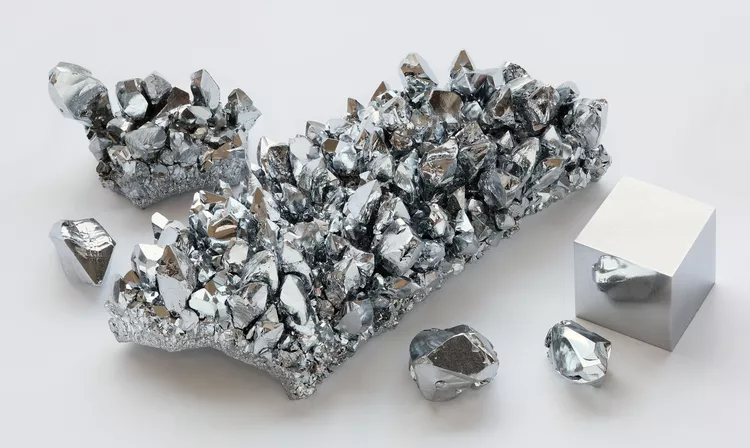
Chromium is a lustrous, corrosion-resistant transition metal famous for creating stainless steel alloys and producing the brilliant green of emeralds and red of rubies.
Simulate concentric quantum energy levels, observe valence electron spins, and examine live atomic clouds in full 3D.
Experiment with Aufbau subshell ordering, explore orbital occupancy, and analyze quantum configuration exceptions.
Instead of the textbook Aufbau filling order [Ar] 3d⁴ 4s², Chromium achieves lowest ground state energy as [Ar] 3d⁵ 4s¹. Half-filled d-subshell (d⁵) provides maximum exchange energy and spherical symmetry, thermodynamically stabilizing the atom over the standard 3d⁴ 4s² state.
Chromium passivates spontaneously in air by forming an ultra-thin, impermeable layer of Cr₂O₃.
Used in stainless steel manufacturing, chrome electroplating, and nichrome resistance heating elements.
Chromium (trivalent Cr³⁺) is a trace essential nutrient that potentiates insulin action in glucose metabolism. Hexavalent Cr⁶⁺ is toxic.
Elements like Chromium are synthesized through stellar nucleosynthesis and supernovae r-processes. On Earth, Chromium is concentrated in specific ore deposits or synthesized in nuclear accelerators.
Chromium (Cr) has an atomic number of 24 and a standard atomic mass of 51.996 u. It is positioned in Period 4, Group 6, in the D-block, and is classified within the Transition Metal category.
The ground-state electron configuration of Chromium is [Ar]3d⁵4s¹. Its 24 electrons are distributed across 4 principal energy levels (2, 8, 13, 1).
Half-filled d-subshell (d⁵) provides maximum exchange energy and spherical symmetry, thermodynamically stabilizing the atom over the standard 3d⁴ 4s² state.
Used in stainless steel manufacturing, chrome electroplating, and nichrome resistance heating elements.