Reactivity & Chemical Bonding
Chemical Behavior & Oxidation States
Carbon is chemically versatile, forming single, double, and triple covalent bonds with diverse elements.
C
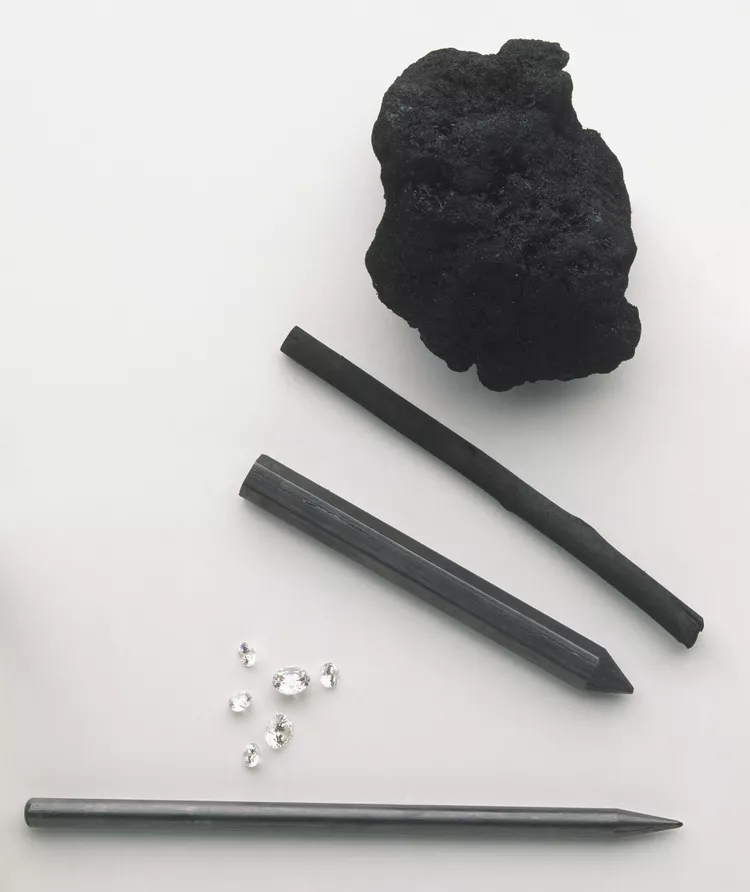
Carbon is the foundational cornerstone of all organic chemistry. Its unique capacity for catenation (forming stable covalent bonds with other carbon atoms) gives rise to millions of biological and synthetic molecules.
Simulate concentric quantum energy levels, observe valence electron spins, and examine live atomic clouds in full 3D.
Experiment with Aufbau subshell ordering, explore orbital occupancy, and analyze quantum configuration exceptions.
Carbon is chemically versatile, forming single, double, and triple covalent bonds with diverse elements.
Employed in carbon fibers, structural steels, lithium-ion battery anodes (graphite), and diamond tools.
Carbon constitutes 18.5% of human body mass, forming the backbone of carbohydrates, lipids, proteins, and nucleic acids.
Elements like Carbon are synthesized through stellar nucleosynthesis and supernovae r-processes. On Earth, Carbon is concentrated in specific ore deposits or synthesized in nuclear accelerators.
Carbon (C) has an atomic number of 6 and a standard atomic mass of 12.011 u. It is positioned in Period 2, Group 14, in the P-block, and is classified within the Reactive Nonmetal category.
The ground-state electron configuration of Carbon is [He]2s²2p². Its 6 electrons are distributed across 2 principal energy levels (2, 4).
Carbon follows standard Aufbau principle orbital filling. Transition metals and heavy elements optimize their shell filling based on subshell exchange energy and electrostatic stability.
Employed in carbon fibers, structural steels, lithium-ion battery anodes (graphite), and diamond tools.