BiologyInteractive SimulatorZero Install100% Free

BloodTransfusion&ABOCompatibility

Explore human hematology and immuno-serology. Test unknown donor and recipient blood samples with Anti-A, Anti-B, and Anti-D serums, observe real-time agglutination clumping, and prevent acute hemolytic transfusion reactions.

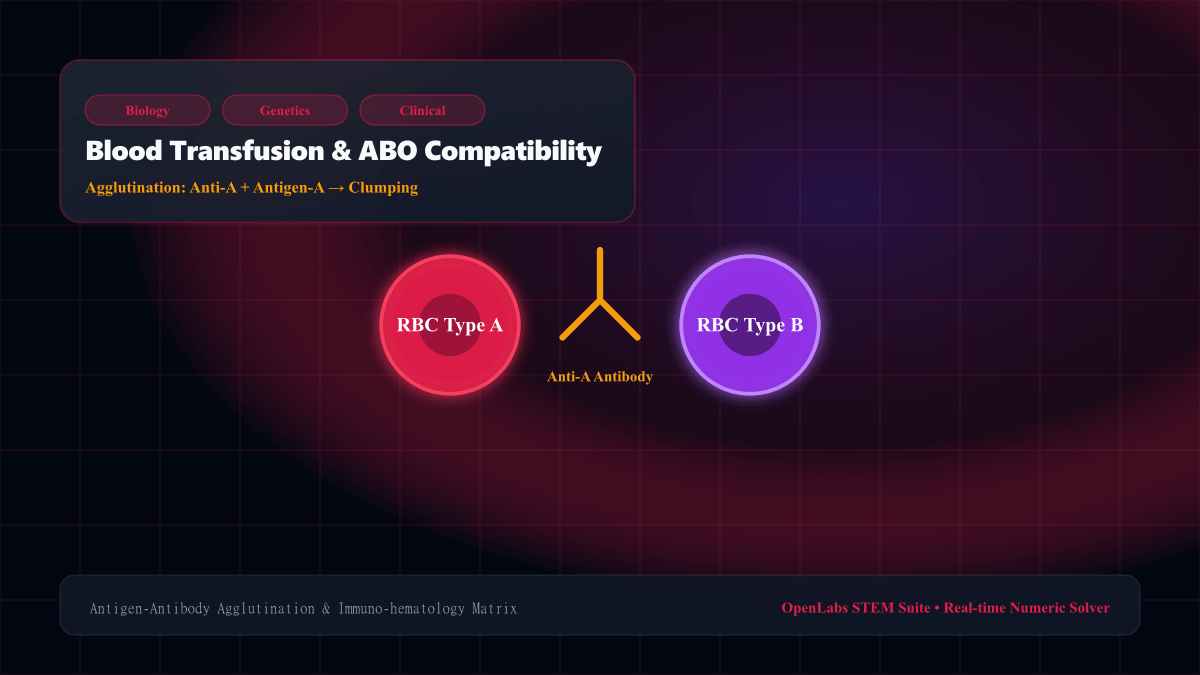
Blood Transfusion & ABO Compatibility interactive Biology simulation illustration
Immuno-Hematology Agglutination Well PlateABO & Rh Antigen Surface Mapping • 16-Cell Transfusion Compatibility Matrix • Emergency O- Crossmatch

Interactive Experiment Guide

Use this studio like a real-time biology workbench

Start with fundamental scientific principles, launch the simulation, and verify mathematical predictions against real-time outcomes.

DisciplineBiology
Simulation ModeInteractive Numeric Engine
Governing ModelImmuno-Hematology Agglutination Well Plate
DeploymentIn-Browser WebAssembly / GPU
01

Scientific Foundation

What is blood transfusion & abo compatibility?

Human blood classification is governed by carbohydrate and protein antigens expressed on the erythrocyte plasma membrane. The ABO system depends on alleles I^A, I^B, and i encoding glycosyltransferases that attach terminal sugars (N-acetylgalactosamine for A-antigen, D-galactose for B-antigen) to the precursor H-antigen. When incompatible blood is transfused, circulating IgM and IgG antibodies bind surface antigens, causing agglutination and fatal complement-mediated hemolysis.

02

Interactive Simulation Flow

Experiment Execution & Governing Equations

Launch the simulation workspace, adjust parameters in real time, and observe the immediate response in the telemetry and graphical indicator loops.

Antigen-Antibody Cross-Linking Reaction\text{Immune Response: } \text{Ag}_A + \text{Ab}_{\text{anti-A}} \xrightarrow{} \text{Agglutination Clumping (Lysis)}

Frequently Asked Questions

Blood Transfusion & ABO Compatibility FAQ

3 Answers

Type O-negative erythrocytes lack surface A-antigens, B-antigens, and Rh(D) antigens. When transfused into a recipient of any blood group, the recipient's plasma antibodies find no foreign antigens to bind against, preventing immune agglutination during emergency resuscitations.

Knowledge Graph & Related Concepts