BiologyInteractive SimulatorZero Install100% Free

AnimalCellOrganelleCytology

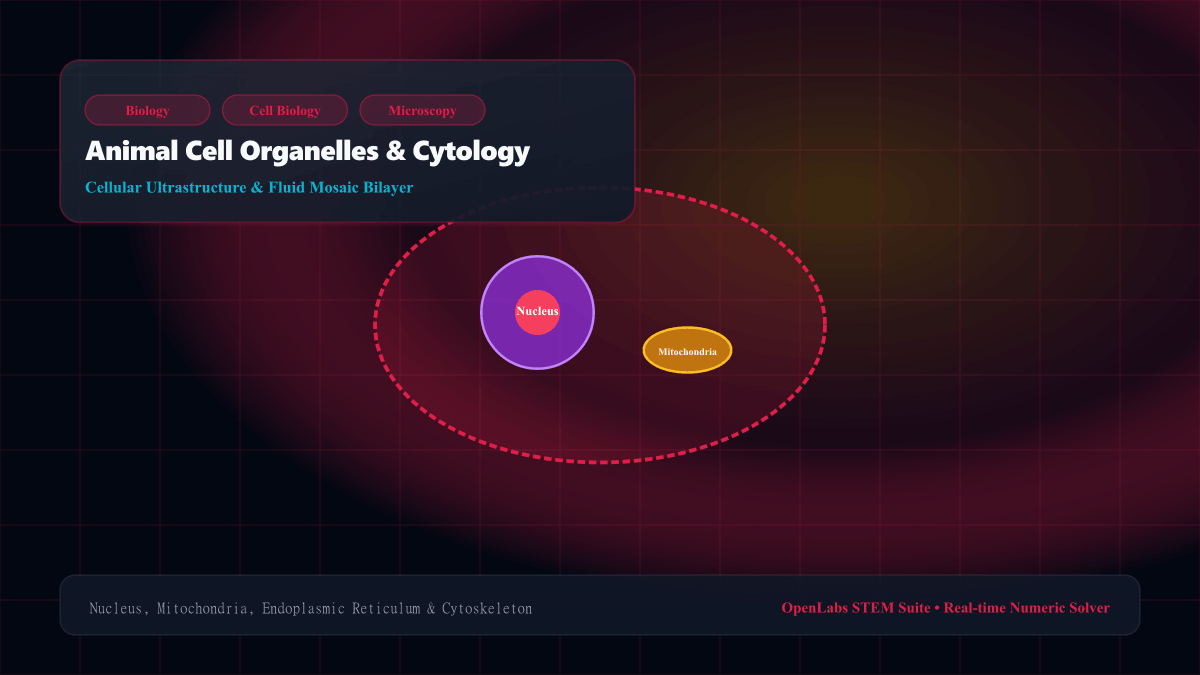
Dissect the inner machinery of eukaryotic life in 3D. Rotate, slice, and isolate animal cell organelles—including the nucleus, rough/smooth ER, Golgi complex, mitochondria, and lysosomes—to understand macromolecular transport and cellular metabolism.

Animal Cell Organelle Cytology interactive Biology simulation illustration
3D Eukaryotic Cell Ultrastructure12 Organelle Callouts • Fluid Mosaic Bilayer • Vesicular Endomembrane Transport

Interactive Experiment Guide

Use this studio like a real-time biology workbench

Start with fundamental scientific principles, launch the simulation, and verify mathematical predictions against real-time outcomes.

DisciplineBiology
Simulation ModeInteractive Numeric Engine
Governing Model3D Eukaryotic Cell Ultrastructure
DeploymentIn-Browser WebAssembly / GPU
01

Scientific Foundation

What is animal cell organelle cytology?

Animal cells are complex eukaryotic systems enclosed by a selectively permeable phospholipid bilayer (the fluid mosaic model) without a rigid cellulose cell wall. Intracellular compartmentalization via endomembrane systems allows distinct biochemical reactions (e.g., DNA replication in the nucleus, oxidative phosphorylation in mitochondria, protein glycosylation in the Golgi) to occur simultaneously in optimized microenvironments.

02

Interactive Simulation Flow

Experiment Execution & Governing Equations

Launch the simulation workspace, adjust parameters in real time, and observe the immediate response in the telemetry and graphical indicator loops.

Surface-Area-to-Volume Ratio & Diffusion Efficiency\text{Cell Size Limit: } \frac{\text{Surface Area}}{\text{Volume}} = \frac{4\pi r^2}{\frac{4}{3}\pi r^3} = \frac{3}{r} \quad (\text{Diffusion Rate Limitation})

Frequently Asked Questions

Animal Cell Organelle Cytology FAQ

3 Answers

Compartmentalization isolates incompatible chemical reactions, concentrates enzymes and substrates for maximum catalytic efficiency, and maintains specialized electrochemical gradients (such as the acidic pH 4.5–5.0 inside lysosomes) without damaging the rest of the cytoplasm.

Knowledge Graph & Related Concepts