BiologyInteractive SimulatorZero Install100% Free

BrainNeuron&ActionPotential

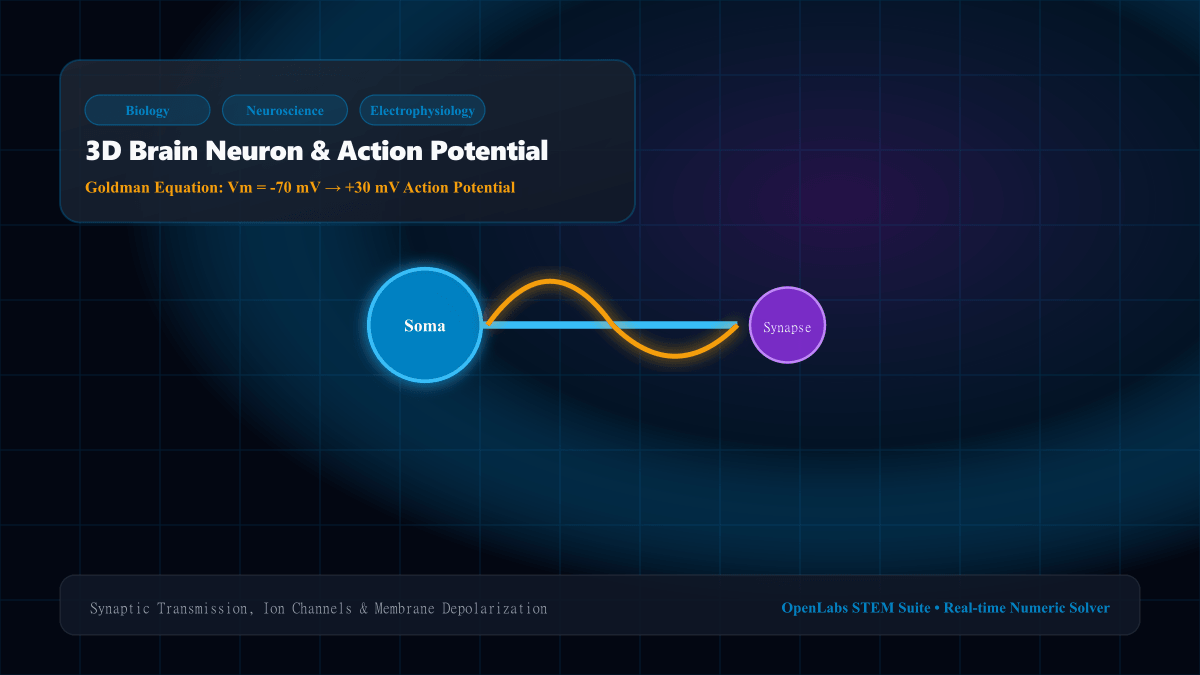
Explore cellular neurophysiology in 3D. Inject current into the neuron soma, observe all-or-none action potential spikes propagating along myelinated axons, and watch calcium-triggered neurotransmitter vesicle exocytosis at the chemical synapse.

Brain Neuron & Action Potential interactive Biology simulation illustration
3D Multipolar Neuron & Chemical SynapseHodgkin-Huxley Voltage Trace • Node of Ranvier Saltatory Conduction • Synaptic Vesicle Exocytosis

Interactive Experiment Guide

Use this studio like a real-time biology workbench

Start with fundamental scientific principles, launch the simulation, and verify mathematical predictions against real-time outcomes.

DisciplineBiology
Simulation ModeInteractive Numeric Engine
Governing Model3D Multipolar Neuron & Chemical Synapse
DeploymentIn-Browser WebAssembly / GPU
01

Scientific Foundation

What is brain neuron & action potential?

Neurons transmit electrical signals via rapid transient reversals of membrane potential called action potentials. At rest, the Na⁺/K⁺ ATPase pump maintains a resting membrane potential around -70 mV. When depolarization reaches the -55 mV threshold, voltage-gated Na⁺ channels open rapidly, driving rapid Na⁺ influx and overshoot to +30 mV. Delayed-rectifier voltage-gated K⁺ channels then open as Na⁺ channels inactivate, driving K⁺ efflux to repolarize and hyperpolarize the membrane.

02

Interactive Simulation Flow

Experiment Execution & Governing Equations

Launch the simulation workspace, adjust parameters in real time, and observe the immediate response in the telemetry and graphical indicator loops.

Goldman-Hodgkin-Katz Voltage EquationV_m = \frac{RT}{F} \ln \left( \frac{P_{\text{K}}[K^+]_o + P_{\text{Na}}[Na^+]_o + P_{\text{Cl}}[Cl^-]_i}{P_{\text{K}}[K^+]_i + P_{\text{Na}}[Na^+]_i + P_{\text{Cl}}[Cl^-]_o} \right)

Frequently Asked Questions

Brain Neuron & Action Potential FAQ

3 Answers

If a graded stimulus depolarizes the axon hillock membrane past the threshold potential (typically around -55 mV), an action potential will fire at full amplitude (+30 mV). Stronger stimuli do not produce larger action potentials; instead, they increase the frequency of firing.

Knowledge Graph & Related Concepts