01
Scientific Foundation
What is cellular respiration & atp synthase?
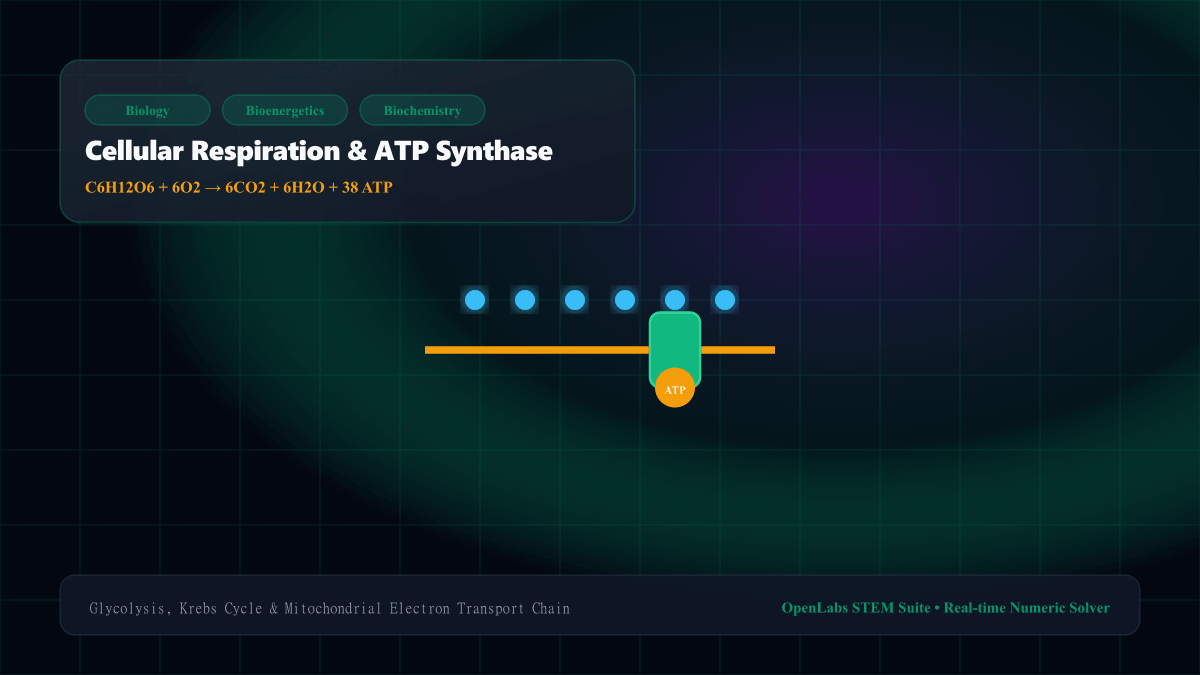
Cellular respiration is the biochemical catabolism of organic fuels to synthesize ATP via oxidative phosphorylation. High-energy electrons from Glycolysis and the Krebs Cycle (carried by NADH and FADH₂) pass down a redox potential ladder in the inner mitochondrial membrane (Complex I → Q → Complex III → Cytochrome c → Complex IV to reduce 1/2 O₂ + 2H⁺ → H₂O). The energy released pumps protons (H⁺) into the intermembrane space, creating a Proton Motive Force (PMF = ΔΨ - (2.3RT/F)ΔpH). Protons diffuse back through the F₀ rotor of ATP Synthase, driving mechanical rotation of the central γ-shaft to catalyze ADP + P_i → ATP.