BiologyInteractive SimulatorZero Install100% Free

EnzymeKinetics&Catalysis

Explore biochemical catalysis at the molecular scale. Control substrate and inhibitor concentrations, adjust environmental temperature and pH, watch induced-fit conformational binding in real time, and trace live Michaelis-Menten saturation and Lineweaver-Burk graphs.

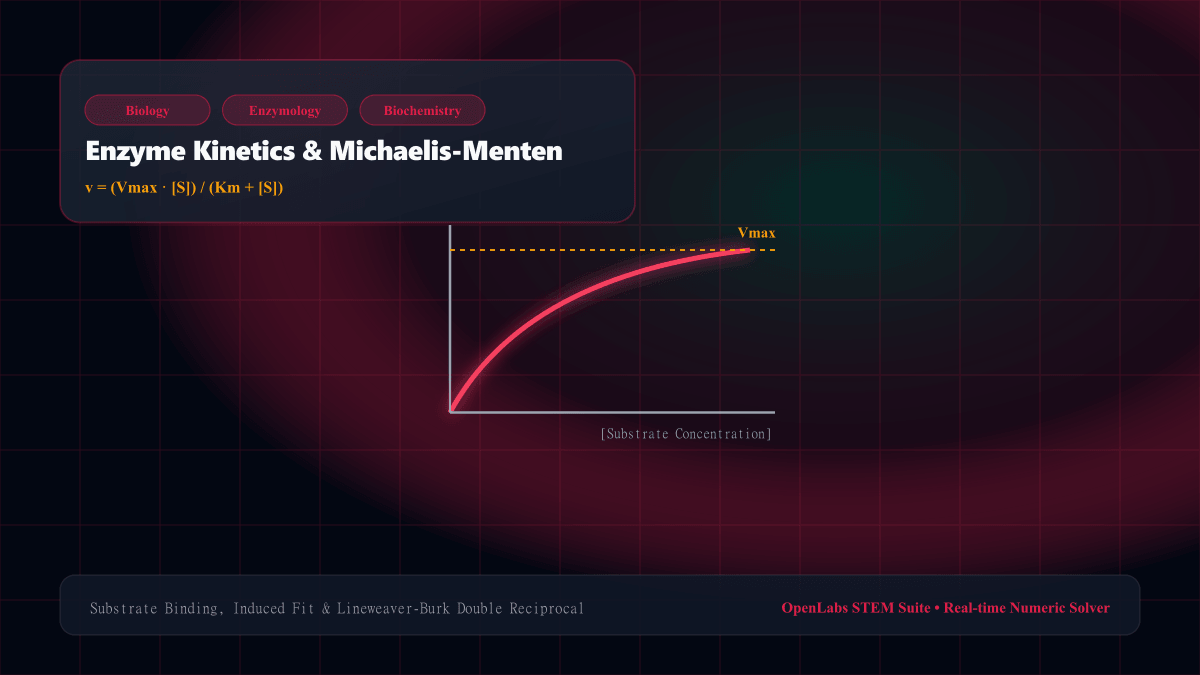
Enzyme Kinetics & Catalysis interactive Biology simulation illustration
Enzymatic Active Site & Kinetic GrapherInduced Fit Substrate Docking • Competitive/Allosteric Modes • Live Lineweaver-Burk Linear Fit

Interactive Experiment Guide

Use this studio like a real-time biology workbench

Start with fundamental scientific principles, launch the simulation, and verify mathematical predictions against real-time outcomes.

DisciplineBiology
Simulation ModeInteractive Numeric Engine
Governing ModelEnzymatic Active Site & Kinetic Grapher
DeploymentIn-Browser WebAssembly / GPU
01

Scientific Foundation

What is enzyme kinetics & catalysis?

Enzymes are specialized protein catalysts that accelerate biochemical reaction rates by stabilizing high-energy transition states and lowering activation energy (E_a). The reaction velocity (v) as a function of substrate concentration [S] follows the hyperbolic Michaelis-Menten equation. The Lineweaver-Burk double reciprocal transformation (1/v vs 1/[S]) yields a linear relationship that clearly distinguishes competitive inhibition (increased apparent K_m, unchanged V_max) from non-competitive allosteric inhibition (decreased V_max, unchanged K_m).

02

Interactive Simulation Flow

Experiment Execution & Governing Equations

Launch the simulation workspace, adjust parameters in real time, and observe the immediate response in the telemetry and graphical indicator loops.

Michaelis-Menten Equation & Lineweaver-Burk Double Reciprocalv = \frac{V_{\max}[S]}{K_m + [S]} \quad \text{and} \quad \frac{1}{v} = \left(\frac{K_m}{V_{\max}}\right)\frac{1}{[S]} + \frac{1}{V_{\max}}

Frequently Asked Questions

Enzyme Kinetics & Catalysis FAQ

3 Answers

K_m is the substrate concentration at which the reaction velocity reaches half of its maximum value (v = 1/2 V_max). A low K_m indicates high enzyme-substrate binding affinity (little substrate needed for half-saturation), whereas a high K_m indicates lower affinity.

Knowledge Graph & Related Concepts