BiologyInteractive SimulatorZero Install100% Free

CardiacCycle,ECG&HeartHemodynamics

Explore the mechanical, electrical, and hemodynamic events of the human heartbeat in real time. Adjust heart rate, preload, contractility, and afterload to observe changes in cardiac output, ejection fraction, ventricular pressures, and heart sounds (S1 Lub and S2 Dub).

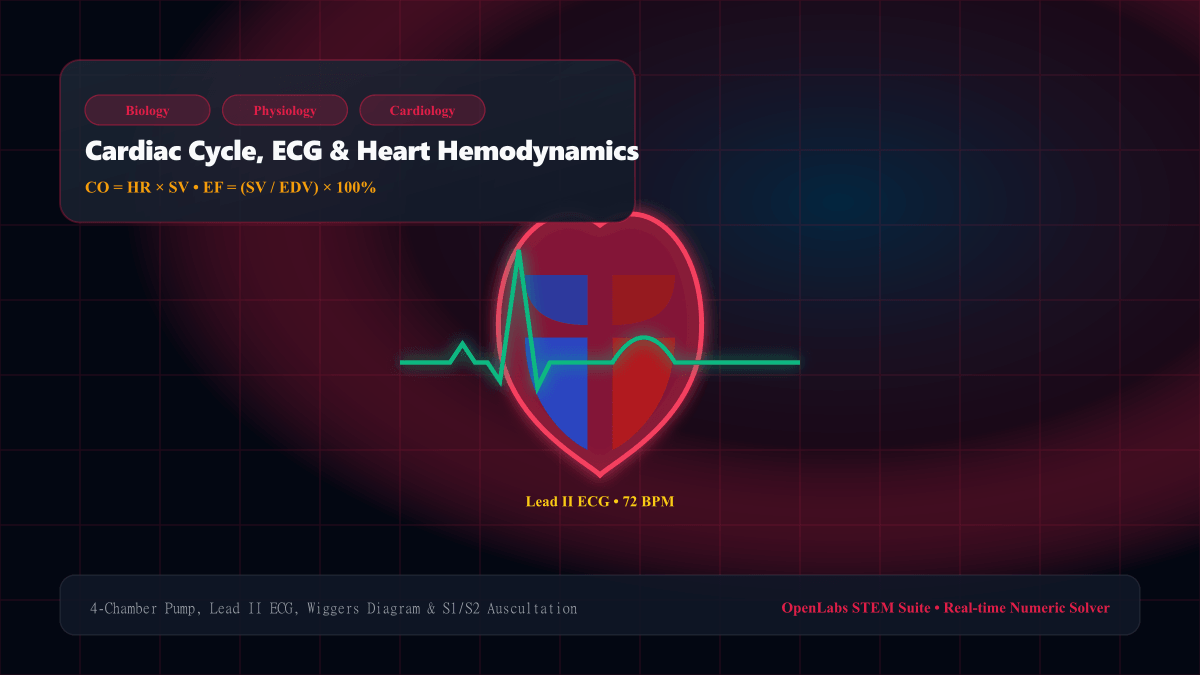
Cardiac Cycle, ECG & Heart Hemodynamics interactive Biology simulation illustration
4-Chamber Heart & Wiggers DiagramInteractive Myocardial Wall • Realtime Lead II ECG • S1/S2 Auscultation • Frank-Starling Hemodynamics

Interactive Experiment Guide

Use this studio like a real-time biology workbench

Start with fundamental scientific principles, launch the simulation, and verify mathematical predictions against real-time outcomes.

DisciplineBiology
Simulation ModeInteractive Numeric Engine
Governing Model4-Chamber Heart & Wiggers Diagram
DeploymentIn-Browser WebAssembly / GPU
01

Scientific Foundation

What is cardiac cycle, ecg & heart hemodynamics?

The human cardiac cycle encompasses all mechanical and electrical events occurring from the beginning of one heartbeat to the beginning of the next. Deoxygenated blood returns via the Vena Cava to the Right Atrium, moves past the Tricuspid valve to the Right Ventricle, and is pumped into the Pulmonary Artery to the lungs. Oxygenated blood returns via the Pulmonary Veins into the Left Atrium, passes the Mitral/Bicuspid valve into the Left Ventricle, and is vigorously ejected across the Aortic valve into the systemic circulation. The cycle is tightly governed by the SA-AV electrical conduction network, the Frank-Starling mechanism (length-tension relationship), and pressure gradients mapped in the classical Wiggers Diagram.

02

Interactive Simulation Flow

Experiment Execution & Governing Equations

Launch the simulation workspace, adjust parameters in real time, and observe the immediate response in the telemetry and graphical indicator loops.

Cardiac Output, Ejection Fraction & Mean Arterial PressureCO = \text{HR} \times \text{SV} \quad \text{and} \quad \text{EF} = \frac{\text{SV}}{\text{EDV}} \times 100\% \quad \text{and} \quad \text{MAP} = \text{DBP} + \frac{1}{3}(\text{SBP} - \text{DBP})

Frequently Asked Questions

Cardiac Cycle, ECG & Heart Hemodynamics FAQ

4 Answers

Systole refers to the phase of contraction when the heart chambers pump blood out (atrial systole pumps blood into the ventricles, and ventricular systole ejects blood into the pulmonary artery and aorta). Diastole is the relaxation phase during which the chambers refill with blood.

Knowledge Graph & Related Concepts