BiologyInteractive SimulatorZero Install100% Free

DihybridCross&IndependentAssortment

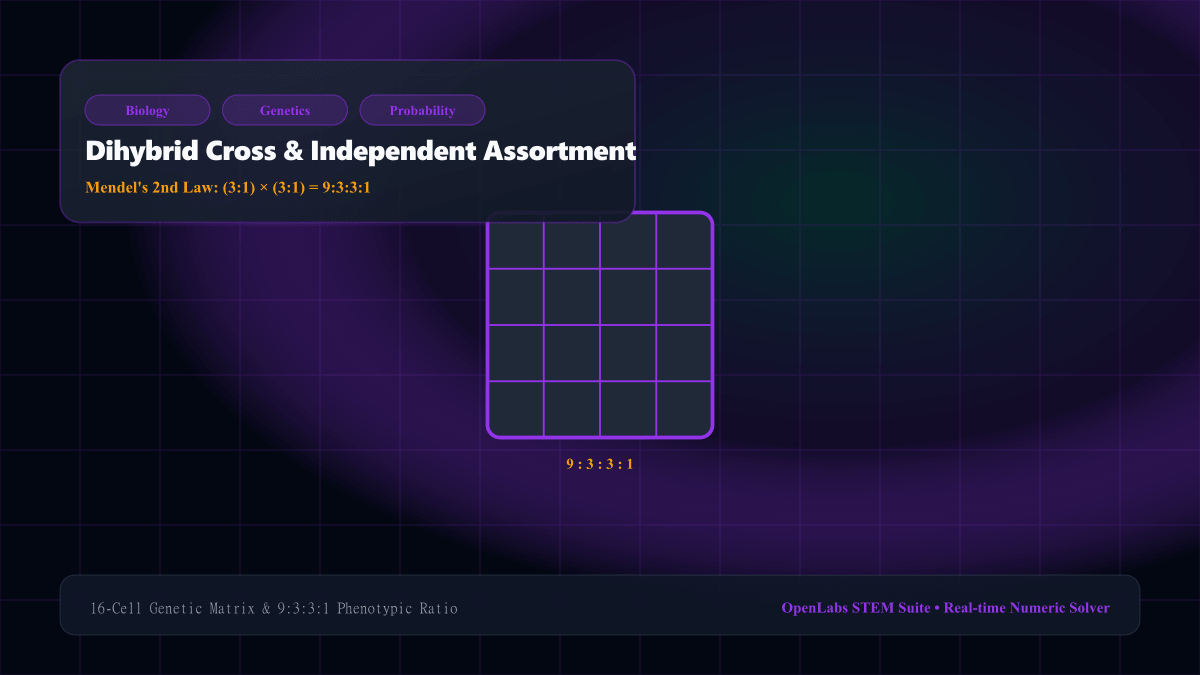
Track two unlinked genetic loci simultaneously across a 4×4 Punnett matrix. Observe how non-homologous chromosome alignment during Meiosis I creates 4 distinct gamete types and yields the classic 9:3:3:1 phenotypic distribution.

Dihybrid Cross & Independent Assortment interactive Biology simulation illustration
4×4 Dihybrid Matrix & Chromosome SorterFOIL Gamete Derivation • 16-Cell Color-Coded Matrix • Statistical Goodness-of-Fit

Interactive Experiment Guide

Use this studio like a real-time biology workbench

Start with fundamental scientific principles, launch the simulation, and verify mathematical predictions against real-time outcomes.

DisciplineBiology
Simulation ModeInteractive Numeric Engine
Governing Model4×4 Dihybrid Matrix & Chromosome Sorter
DeploymentIn-Browser WebAssembly / GPU
01

Scientific Foundation

What is dihybrid cross & independent assortment?

Mendel's Second Law—the Law of Independent Assortment—states that alleles of two or more different genes sort into gametes independently of one another during meiosis. This holds true for genes located on separate chromosomes or far apart on the same chromosome. Crossing heterozygous dihybrids (RrYy × RrYy) generates 4 gamete classes (RY, Ry, rY, ry) that combine into 16 genotypic possibilities and 4 distinct phenotypic classes in a 9:3:3:1 ratio.

02

Interactive Simulation Flow

Experiment Execution & Governing Equations

Launch the simulation workspace, adjust parameters in real time, and observe the immediate response in the telemetry and graphical indicator loops.

Dihybrid Independent Assortment Combinatorial Expansion\text{Product Law: } (3:1) \times (3:1) = 9 \text{ Dom/Dom} : 3 \text{ Dom/Rec} : 3 \text{ Rec/Dom} : 1 \text{ Rec/Rec}

Frequently Asked Questions

Dihybrid Cross & Independent Assortment FAQ

2 Answers

Independent assortment fails when two genes reside physically close to each other on the same chromosome (syntenic genetic linkage). Linked genes tend to be inherited together as a unit unless broken up by meiotic homologous crossing-over.

Knowledge Graph & Related Concepts