BiologyInteractive SimulatorZero Install100% Free

PedigreeTree&InheritancePatterns

Step into the role of a clinical genetic counselor. Trace inheritance of conditions (Huntington's, Cystic Fibrosis, Hemophilia) across multi-generational family trees, deduce unknown genotypes, and calculate recurrence probabilities for future offspring.

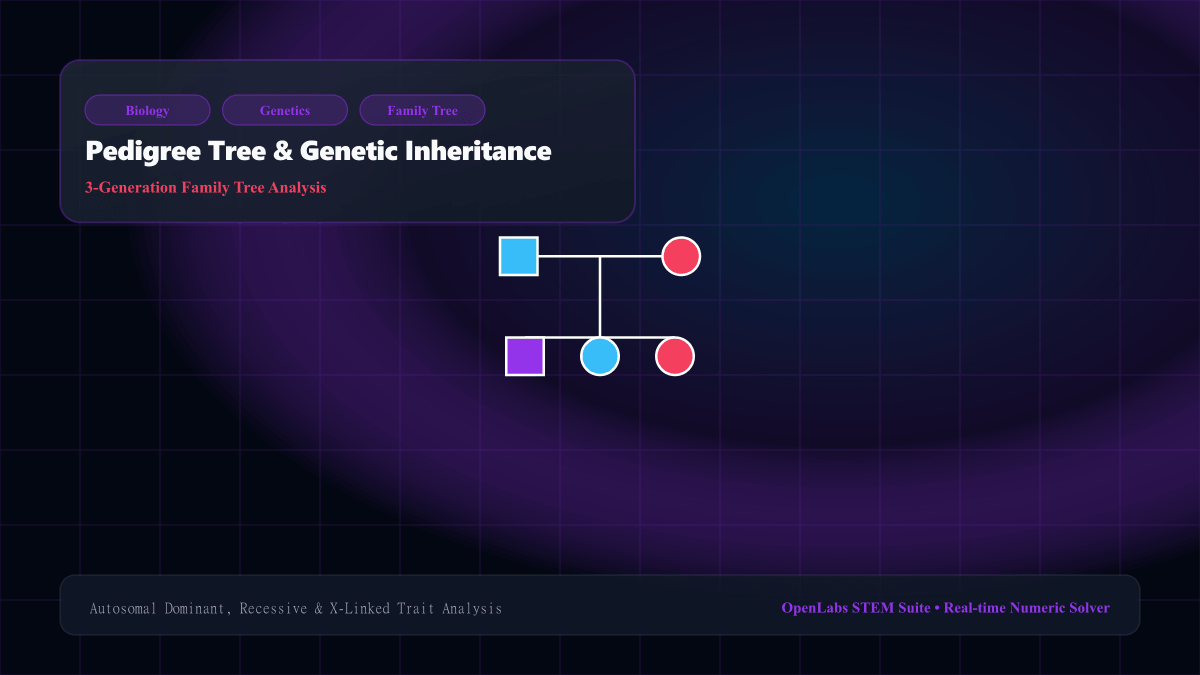
Pedigree Tree & Inheritance Patterns interactive Biology simulation illustration
3-Generation Interactive Pedigree ChartStandard Symbology (Squares/Circles) • Autosomal & Sex-Linked Modes • Genotype Risk Evaluator

Interactive Experiment Guide

Use this studio like a real-time biology workbench

Start with fundamental scientific principles, launch the simulation, and verify mathematical predictions against real-time outcomes.

DisciplineBiology
Simulation ModeInteractive Numeric Engine
Governing Model3-Generation Interactive Pedigree Chart
DeploymentIn-Browser WebAssembly / GPU
01

Scientific Foundation

What is pedigree tree & inheritance patterns?

A pedigree chart is a genealogical diagram that tracks the phenotypic expression and transmission of specific genetic traits across multiple generations. Key inheritance criteria include: (1) Autosomal Dominant traits do not skip generations; affected individuals have at least one affected parent, (2) Autosomal Recessive traits often skip generations from unaffected carrier parents (Aa × Aa → 25% aa), and (3) X-Linked Recessive traits predominantly affect males (hemizygous X^b Y) via carrier mothers (X^B X^b).

02

Interactive Simulation Flow

Experiment Execution & Governing Equations

Launch the simulation workspace, adjust parameters in real time, and observe the immediate response in the telemetry and graphical indicator loops.

Clinical Genetic Risk Probability & Bayesian Pedigree Formula\text{Bayesian Risk Calculation: } P(\text{Carrier} \mid \text{Unaffected Offspring}) = \frac{P(\text{Prior}) \times P(\text{Conditional})}{\sum P(\text{Joint})}

Frequently Asked Questions

Pedigree Tree & Inheritance Patterns FAQ

2 Answers

X-Linked Recessive conditions (e.g., Red-Green Color Blindness, Hemophilia A) appear far more frequently in males because males have only one X chromosome (hemizygous). Affected fathers cannot transmit the trait to their sons, but all of their daughters become obligate carriers.

Knowledge Graph & Related Concepts