ChemistryInteractive SimulatorZero Install100% Free

ElectrochemicalGalvanic&ElectrolyticCells

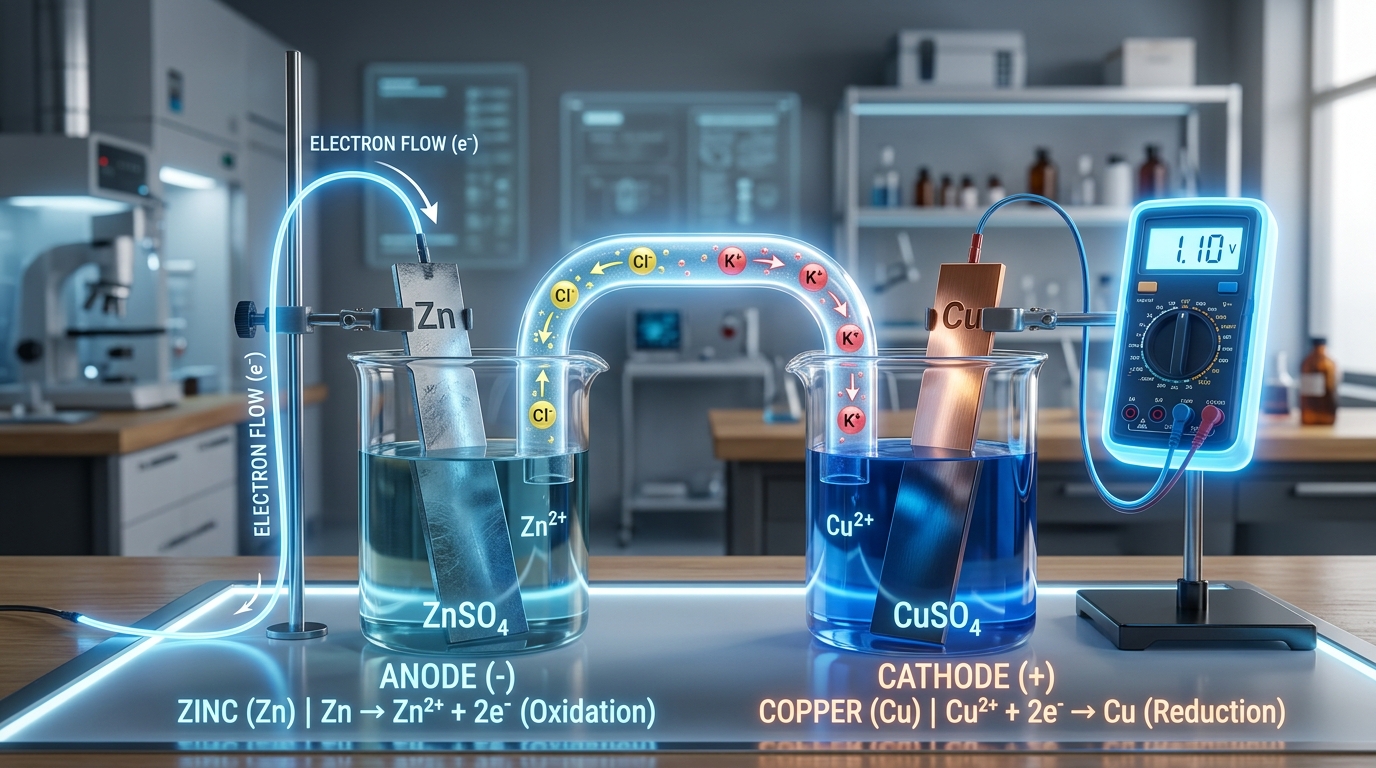
Build custom electrochemical half-cells by pairing metal electrodes (Zn, Cu, Ag, Fe, Pb, Al, Mg). Observe real-time electron flow through external circuit wires, salt bridge ion migration, anode dissolution, cathode electroplating, and Nernst equation voltage shifts.

Electrochemical Galvanic & Electrolytic Cells interactive Chemistry simulation illustration
Dual Half-Cell Electrochemistry BenchGalvanic & Electrolytic Modes • Salt Bridge Ion Animation • Live Nernst Voltmeter

Interactive Experiment Guide

Use this studio like a real-time chemistry workbench

Start with fundamental scientific principles, launch the simulation, and verify mathematical predictions against real-time outcomes.

DisciplineChemistry
Simulation ModeInteractive Numeric Engine
Governing ModelDual Half-Cell Electrochemistry Bench
DeploymentIn-Browser WebAssembly / GPU
01

Scientific Foundation

What is electrochemical galvanic & electrolytic cells?

Electrochemistry investigates the interconversion of chemical energy and electrical energy through redox (oxidation-reduction) reactions. In a Galvanic cell, spontaneous redox reactions (ΔG < 0) drive electron flow from the anode (oxidation: M → Mⁿ⁺ + ne⁻) to the cathode (reduction: Mⁿ⁺ + ne⁻ → M). In an Electrolytic cell, an external potential overrides thermodynamics to force non-spontaneous reactions (ΔG > 0).

02

Interactive Simulation Flow

Experiment Execution & Governing Equations

Launch the simulation workspace, adjust parameters in real time, and observe the immediate response in the telemetry and graphical indicator loops.

Nernst Concentration Equation & Free Energy RelationE_{\text{cell}} = E^\circ_{\text{cell}} - \frac{RT}{nF} \ln Q \quad \text{and} \quad \Delta G^\circ = -n F E^\circ_{\text{cell}}

Frequently Asked Questions

Electrochemical Galvanic & Electrolytic Cells FAQ

3 Answers

As electrons flow from anode to cathode, excess positive charge builds up in the anode beaker (due to Zn²⁺ generation) while excess negative charge builds up in the cathode beaker (as Cu²⁺ is consumed). The salt bridge permits spectator ions (e.g., K⁺ and Cl⁻) to migrate and maintain electrical neutrality, preventing polarization from stopping the current.

Knowledge Graph & Related Concepts