ChemistryInteractive SimulatorZero Install100% Free

FlameTest&AtomicEmissionSpectrometry

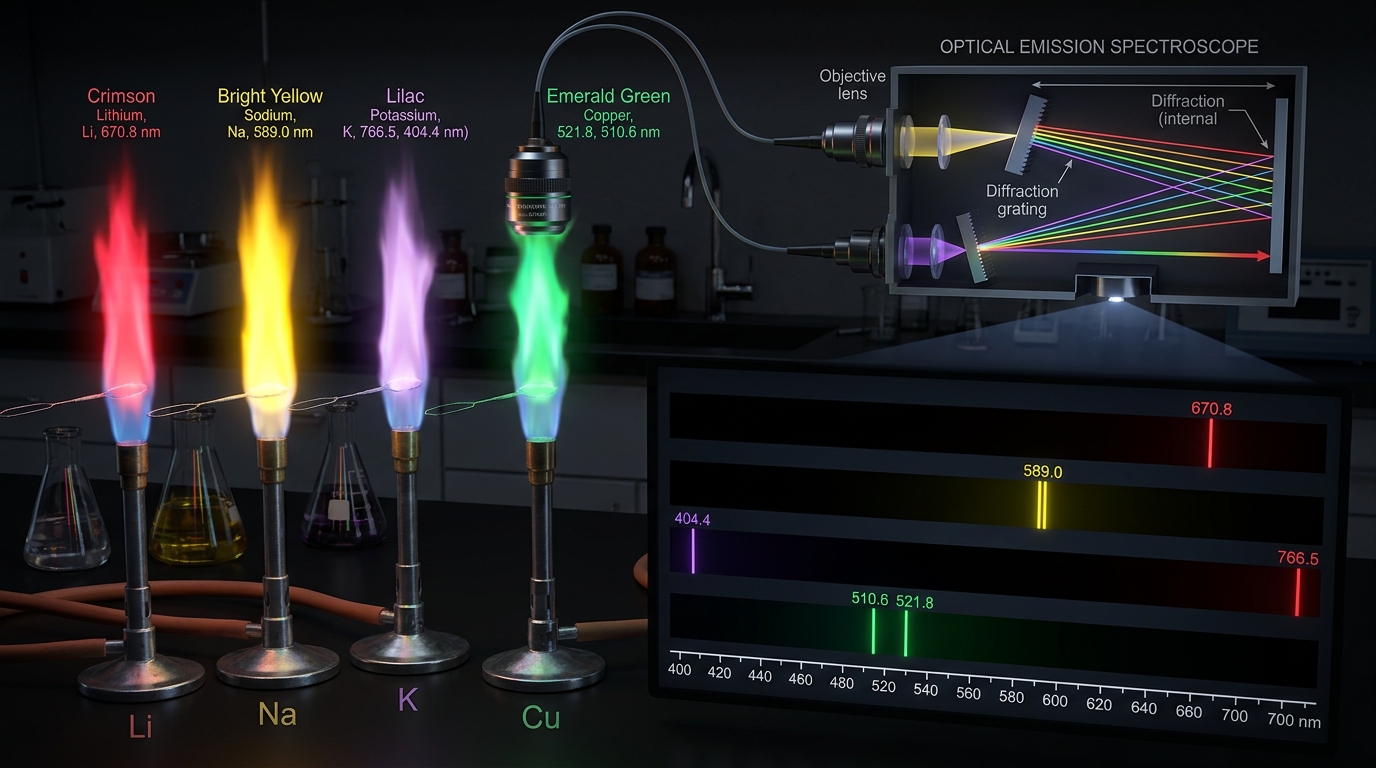
Immerse in virtual qualitative chemical analysis. Dip platinum wire loops into aqueous salt solutions (Na⁺, K⁺, Cu²⁺, Sr²⁺, Ba²⁺, Li⁺, Ca²⁺), introduce them into the Bunsen flame, observe characteristic flame colors, and view discrete spectral emission lines.

Flame Test & Atomic Emission Spectrometry interactive Chemistry simulation illustration
Bunsen Burner & Optical Spectroscope7 Metal Salt Solutions • Discrete Emission Line Analyzer • Bunsen Air Collar Control

Interactive Experiment Guide

Use this studio like a real-time chemistry workbench

Start with fundamental scientific principles, launch the simulation, and verify mathematical predictions against real-time outcomes.

DisciplineChemistry
Simulation ModeInteractive Numeric Engine
Governing ModelBunsen Burner & Optical Spectroscope
DeploymentIn-Browser WebAssembly / GPU
01

Scientific Foundation

What is flame test & atomic emission spectrometry?

When a metal salt enters the thermal zone of a Bunsen flame, thermal energy vaporizes the sample and excites valence electrons into higher, unstable quantized energy orbitals. When electrons relax back to lower ground states, the energy difference is emitted as a photon of light governed by the Planck-Einstein relation (ΔE = hν = hc/λ). Because every element has unique energy level spacing, the resulting emission spectrum acts as a definitive optical fingerprint.

02

Interactive Simulation Flow

Experiment Execution & Governing Equations

Launch the simulation workspace, adjust parameters in real time, and observe the immediate response in the telemetry and graphical indicator loops.

Planck-Einstein Relation & Rydberg Formula\Delta E = E_2 - E_1 = h\nu = \frac{hc}{\lambda} \quad (\text{Rydberg: } \frac{1}{\lambda} = R_H Z^2 \left(\frac{1}{n_1^2} - \frac{1}{n_2^2}\right))

Frequently Asked Questions

Flame Test & Atomic Emission Spectrometry FAQ

3 Answers

Each element has a distinct number of protons in its nucleus, which establishes unique quantized orbital energy levels. The energy differences (ΔE) between excited and ground states correspond to specific photon wavelengths (λ = hc/ΔE) within the visible spectrum.

Knowledge Graph & Related Concepts