ChemistryInteractive SimulatorZero Install100% Free

GasLaws&KineticTheory

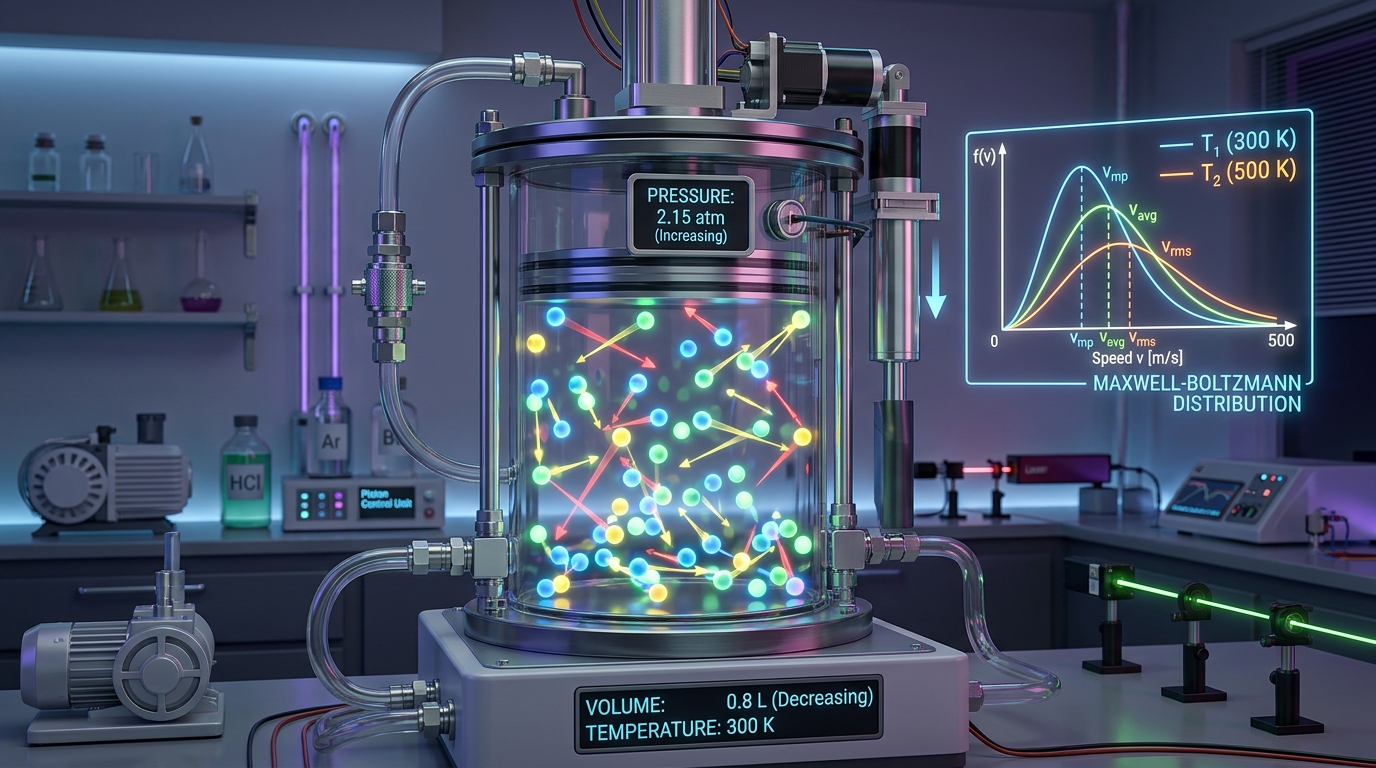
Control gas pressure, volume, temperature, and molecular count in real time. Drag the weighted piston cylinder, adjust the thermal heat bath, and observe how thousands of elastic molecular impacts generate pressure and trace Maxwell-Boltzmann velocity distributions.

Gas Laws & Kinetic Theory interactive Chemistry simulation illustration
2D Elastic Particle Piston ChamberBoyle's, Charles's & Gay-Lussac Modes • Real-Time Maxwell-Boltzmann Curve • RMS Velocity

Interactive Experiment Guide

Use this studio like a real-time chemistry workbench

Start with fundamental scientific principles, launch the simulation, and verify mathematical predictions against real-time outcomes.

DisciplineChemistry
Simulation ModeInteractive Numeric Engine
Governing Model2D Elastic Particle Piston Chamber
DeploymentIn-Browser WebAssembly / GPU
01

Scientific Foundation

What is gas laws & kinetic theory?

The Kinetic Molecular Theory (KMT) of gases explains macroscopic thermodynamic variables (P, V, T, n) through microscopic particle mechanics. Particles in continuous, random linear motion undergo elastic collisions with container walls, imparting momentum that manifests as pressure (P = F/A). Temperature is a direct measure of average molecular kinetic energy (KE_avg = 3/2 k_B T), with particle speeds following the statistical Maxwell-Boltzmann distribution.

02

Interactive Simulation Flow

Experiment Execution & Governing Equations

Launch the simulation workspace, adjust parameters in real time, and observe the immediate response in the telemetry and graphical indicator loops.

Ideal Gas Equation & Maxwell-Boltzmann Speed DistributionPV = nRT \quad \text{and} \quad v_{\text{rms}} = \sqrt{\frac{3RT}{M}} \quad \text{and} \quad f(v) = 4\pi \left(\frac{m}{2\pi k_B T}\right)^{3/2} v^2 e^{-\frac{mv^2}{2k_BT}}

Frequently Asked Questions

Gas Laws & Kinetic Theory FAQ

3 Answers

Every time a gas molecule bounces elastically off a container wall, its velocity vector reverses, resulting in a momentum transfer (Δp = 2mv_x). The total force is the rate of momentum transfer from billions of collisions per second; dividing this force by the wall area gives the macroscopic pressure.

Knowledge Graph & Related Concepts