ChemistryInteractive SimulatorZero Install100% Free

3DMolecularGeometry&VSEPRTheory

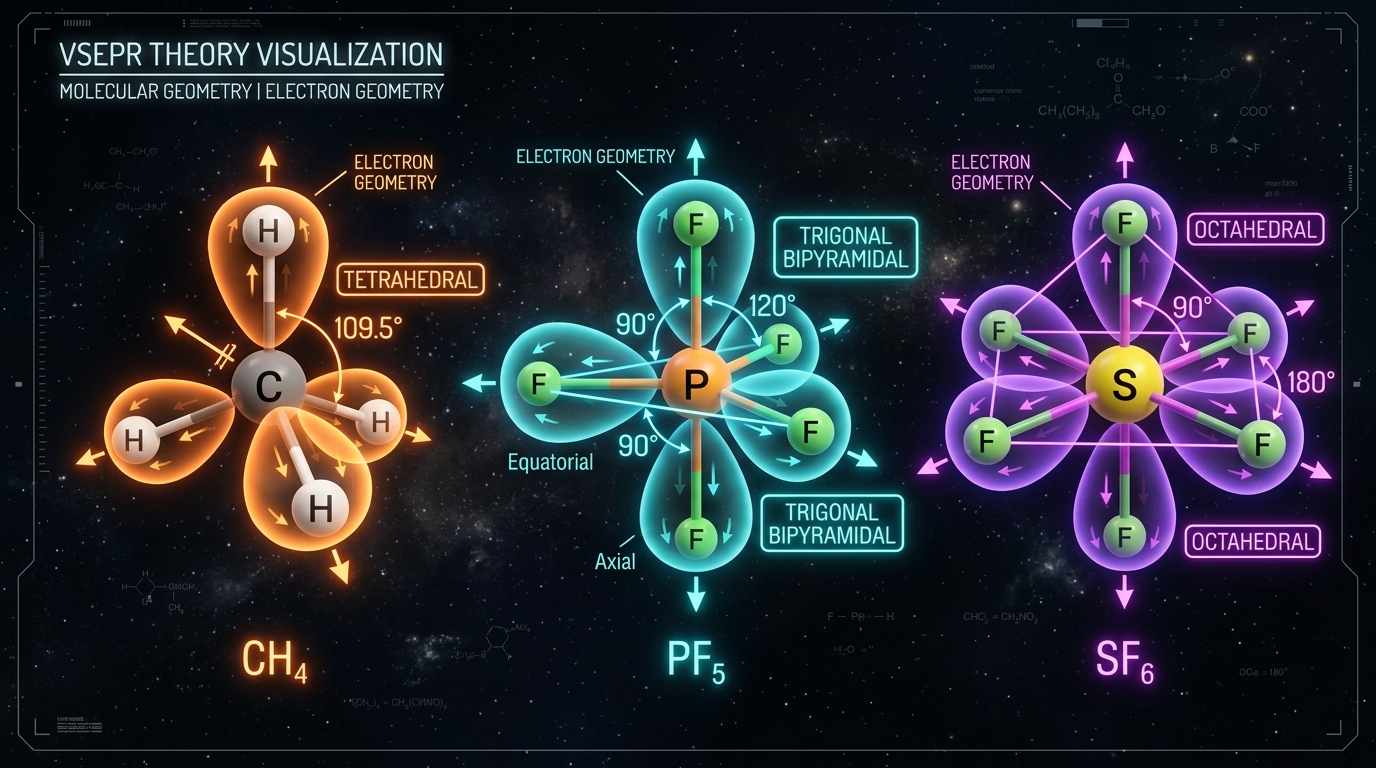
Rotate and manipulate 3D molecular geometries in real time. Adjust bonded atoms and lone electron pairs to observe dynamic spatial arrangements across all steric numbers (AX₂ to AX₆), orbital hybridizations (sp to sp³d²), and polarity vectors.

3D Molecular Geometry & VSEPR Theory interactive Chemistry simulation illustration
3D Rotatable Ball-and-Stick WorkbenchSteric Numbers 2 to 6 • Lone Pair Cloud Isosurfaces • 3D Dipole Vector Sum

Interactive Experiment Guide

Use this studio like a real-time chemistry workbench

Start with fundamental scientific principles, launch the simulation, and verify mathematical predictions against real-time outcomes.

DisciplineChemistry
Simulation ModeInteractive Numeric Engine
Governing Model3D Rotatable Ball-and-Stick Workbench
DeploymentIn-Browser WebAssembly / GPU
01

Scientific Foundation

What is 3d molecular geometry & vsepr theory?

Valence Shell Electron Pair Repulsion (VSEPR) theory states that electron domains around a central atom repel one another electrostatically, adopting spatial geometries that maximize angular separation. Because non-bonding lone pairs are localized on only one nucleus, they exert stronger repulsion than bonding pairs (Lone Pair-Lone Pair > Lone Pair-Bond Pair > Bond Pair-Bond Pair), causing predictable compression of adjacent bond angles below ideal values.

02

Interactive Simulation Flow

Experiment Execution & Governing Equations

Launch the simulation workspace, adjust parameters in real time, and observe the immediate response in the telemetry and graphical indicator loops.

VSEPR Notation & Steric NumberAX_m E_n \quad \text{Steric Number } (SN) = m + n \quad (\text{Bond Angle Compression } \Delta\theta \approx 2.5^\circ / \text{lone pair})

Frequently Asked Questions

3D Molecular Geometry & VSEPR Theory FAQ

3 Answers

Electron geometry describes the spatial arrangement of all electron domains (both bonding pairs and lone pairs) around the central atom. Molecular geometry describes only the spatial arrangement of the bonded atomic nuclei. For example, water has a tetrahedral electron geometry but a bent molecular geometry.

Knowledge Graph & Related Concepts