MathematicsInteractive SimulatorZero Install100% Free

Calculus,Derivatives&RiemannIntegrals

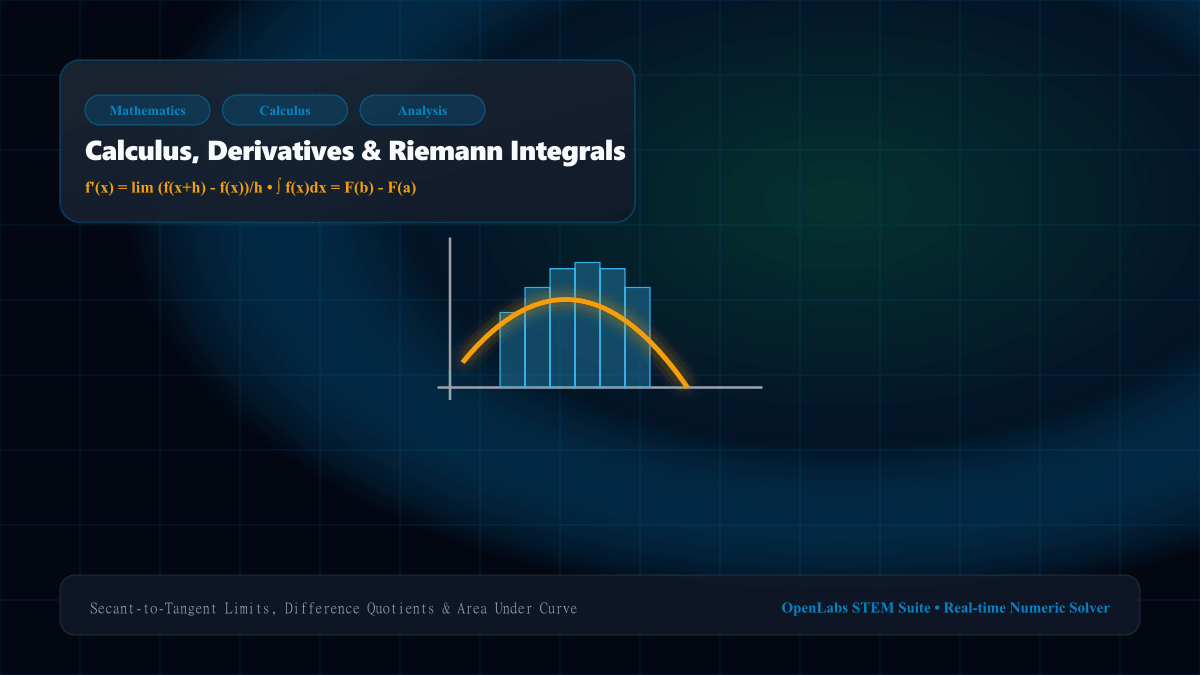
Bridge the geometric and analytic foundations of rates of change and accumulated area. Drag the step-size delta-x to observe secant lines converge onto instantaneous tangent slopes, and increase partition counts to see Riemann sum bars refine into smooth definite integrals.

Calculus, Derivatives & Riemann Integrals interactive Mathematics simulation illustration
Interactive Tangent & Riemann Sum WorkbenchSecant-to-Tangent Limit Slider (h → 0) • Left/Right/Midpoint/Trapezoid/Simpson Rules • Partition Count n = 2 to 200

Interactive Experiment Guide

Use this studio like a real-time mathematics workbench

Start with fundamental scientific principles, launch the simulation, and verify mathematical predictions against real-time outcomes.

DisciplineMathematics
Simulation ModeInteractive Numeric Engine
Governing ModelInteractive Tangent & Riemann Sum Workbench
DeploymentIn-Browser WebAssembly / GPU
01

Scientific Foundation

What is calculus, derivatives & riemann integrals?

Calculus is the mathematical study of continuous change and accumulation. Differential calculus defines the instantaneous rate of change (derivative) via the limit of difference quotients as h → 0. Integral calculus defines the accumulated area under a curve via the limit of Riemann sums as partition width Δx → 0. The Fundamental Theorem of Calculus links both branches, proving that differentiation and integration are inverse operations.

02

Interactive Simulation Flow

Experiment Execution & Governing Equations

Launch the simulation workspace, adjust parameters in real time, and observe the immediate response in the telemetry and graphical indicator loops.

Definition of the Derivative & Fundamental Theorem of Calculusf'(x) = \lim_{h \to 0}\frac{f(x+h) - f(x)}{h} \quad \text{and} \quad \int_a^b f(x)\,dx = \lim_{n \to \infty} \sum_{i=1}^n f(x_i^*) \Delta x = F(b) - F(a)

Frequently Asked Questions

Calculus, Derivatives & Riemann Integrals FAQ

2 Answers

Calculating the average rate of change over an interval h gives Δy/h. When h is exactly 0, Δy/Δx becomes the undefined indeterminate form 0/0. The mathematical limit investigates the trend of the quotient as h approaches arbitrarily close to 0 without actually reaching 0, yielding a well-defined instantaneous slope.

Knowledge Graph & Related Concepts