MathematicsInteractive SimulatorZero Install100% Free

Trigonometry&UnitCircleDynamics

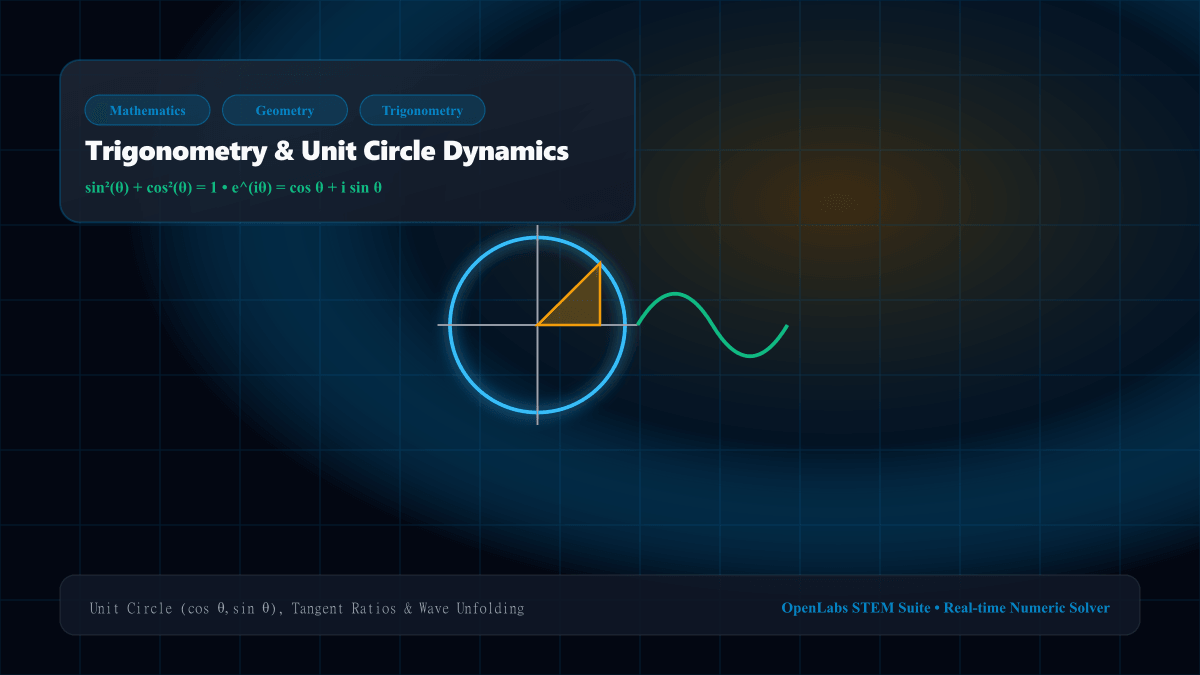
Bridge right-triangle ratios (SOH-CAH-TOA), circular rotational kinematics, and continuous periodic sinusoidal waves. Drag the angle radial arm on the Unit Circle (r = 1) to observe real-time trigonometric projections.

Trigonometry & Unit Circle Dynamics interactive Mathematics simulation illustration
Interactive Unit Circle & Wave ProjectorRadians & Degrees Selector • Real-time (x, y) = (cos θ, sin θ) Coordinate HUD • Live Sine & Cosine Wave Unfolding

Interactive Experiment Guide

Use this studio like a real-time mathematics workbench

Start with fundamental scientific principles, launch the simulation, and verify mathematical predictions against real-time outcomes.

DisciplineMathematics
Simulation ModeInteractive Numeric Engine
Governing ModelInteractive Unit Circle & Wave Projector
DeploymentIn-Browser WebAssembly / GPU
01

Scientific Foundation

What is trigonometry & unit circle dynamics?

Trigonometry extends right-triangle geometry to continuous periodic functions on the Cartesian plane via the Unit Circle (x² + y² = 1). For any angle θ measured counterclockwise from the positive x-axis, the coordinates of the terminal point on the circle are x = cos θ and y = sin θ, while the tangent is the slope of the radial line (tan θ = sin θ / cos θ). Projecting y(θ) continuously onto a moving time axis unfolds the fundamental sinusoidal wave.

02

Interactive Simulation Flow

Experiment Execution & Governing Equations

Launch the simulation workspace, adjust parameters in real time, and observe the immediate response in the telemetry and graphical indicator loops.

Pythagorean Identity & Euler's Formula\sin^2\theta + \cos^2\theta = 1 \quad \text{and} \quad e^{i\theta} = \cos\theta + i\sin\theta \quad \text{and} \quad \tan\theta = \frac{\sin\theta}{\cos\theta}

Frequently Asked Questions

Trigonometry & Unit Circle Dynamics FAQ

2 Answers

On a unit circle of radius r = 1, any angle θ defines a right triangle with adjacent side x = cos θ, opposite side y = sin θ, and hypotenuse r = 1. Applying the Pythagorean theorem (a² + b² = c²) gives (cos θ)² + (sin θ)² = 1².

Knowledge Graph & Related Concepts