MathematicsInteractive SimulatorZero Install100% Free

Polynomials&DiscriminantStudio

Explore polynomial algebra from linear and quadratic equations up to degree-5 quintics. Adjust coefficients in real time to observe root bifurcations, vertex shifts, focus-directrix geometry, and polynomial factorizations.

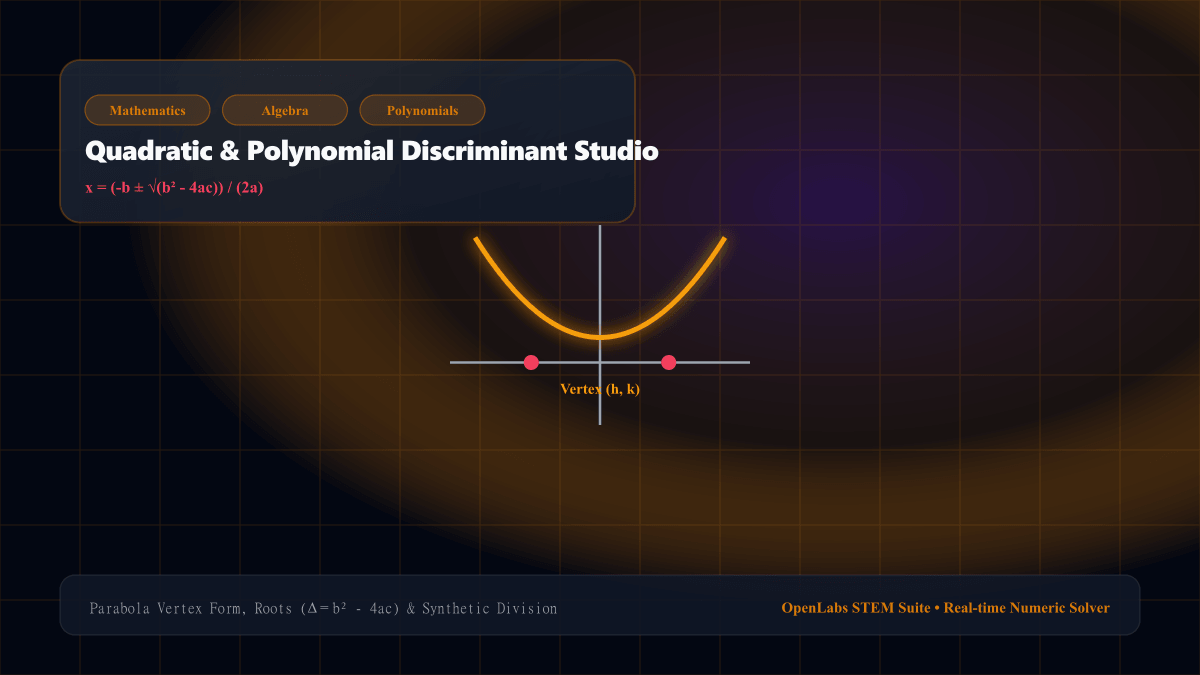
Polynomials & Discriminant Studio interactive Mathematics simulation illustration
Dynamic Polynomial Curve & Root AnalyzerInteractive Degree 1–5 Selector • Discriminant Root Classifier • Live Synthetic Division Steps

Interactive Experiment Guide

Use this studio like a real-time mathematics workbench

Start with fundamental scientific principles, launch the simulation, and verify mathematical predictions against real-time outcomes.

DisciplineMathematics
Simulation ModeInteractive Numeric Engine
Governing ModelDynamic Polynomial Curve & Root Analyzer
DeploymentIn-Browser WebAssembly / GPU
01

Scientific Foundation

What is polynomials & discriminant studio?

A polynomial function P(x) = a_n x^n + ... + a_1 x + a_0 has degree n. By the Fundamental Theorem of Algebra, every degree-n polynomial with complex coefficients has exactly n complex roots (counted with multiplicity). For quadratic equations (ax² + bx + c = 0), the discriminant Δ = b² - 4ac governs root nature: Δ > 0 yields two distinct real roots, Δ = 0 yields one repeated real root, and Δ < 0 yields a complex conjugate pair on the Argand plane.

02

Interactive Simulation Flow

Experiment Execution & Governing Equations

Launch the simulation workspace, adjust parameters in real time, and observe the immediate response in the telemetry and graphical indicator loops.

Quadratic Formula, Discriminant & Parabolic Vertexx = \frac{-b \pm \sqrt{b^2 - 4ac}}{2a} \quad \text{and} \quad \Delta = b^2 - 4ac \quad \text{and} \quad \text{Vertex: } \left(-\frac{b}{2a}, c - \frac{b^2}{4a}\right)

Frequently Asked Questions

Polynomials & Discriminant Studio FAQ

2 Answers

When Δ < 0, the parabola never crosses or touches the x-axis in the real Cartesian plane (it floats entirely above or below the axis). Its two roots are complex numbers with imaginary components: x = (-b ± i√|Δ|) / (2a).

Knowledge Graph & Related Concepts