MathematicsInteractive SimulatorZero Install100% Free

FunctionGrapher&CurveTransformations

Explore continuous functions, polynomial roots, amplitude and frequency scalings, horizontal/vertical translations, and numerical tangents in a real-time vector mathematical sandbox.

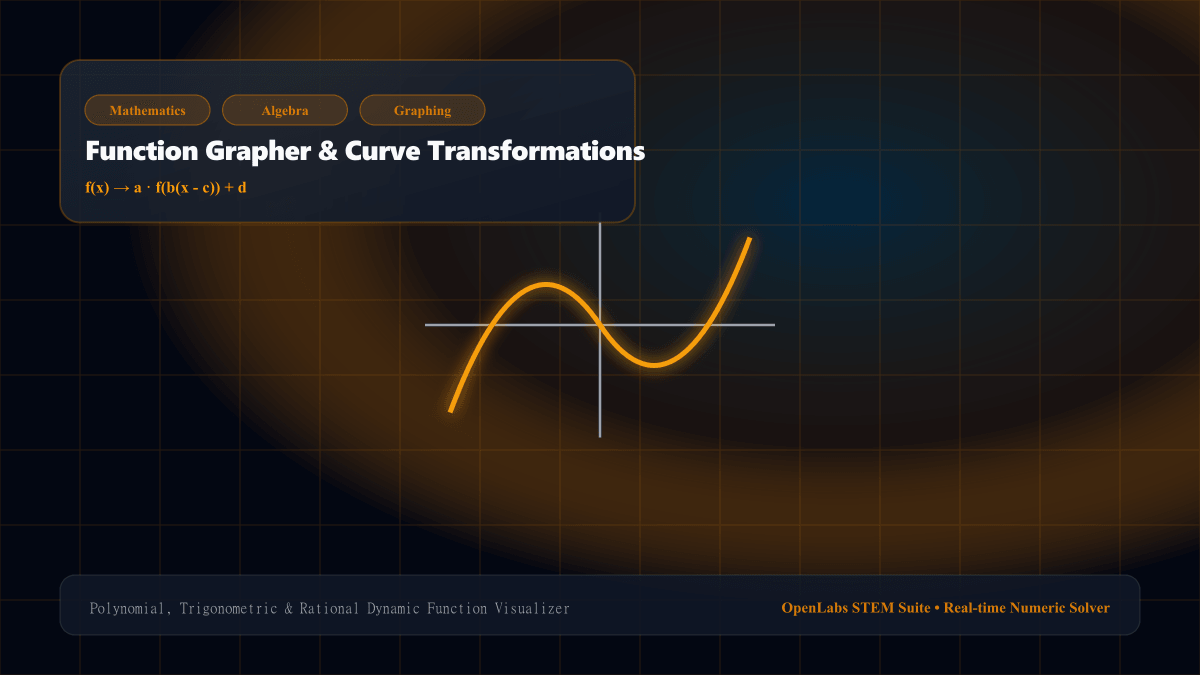
Function Grapher & Curve Transformations interactive Mathematics simulation illustration
Real-Time D3 Function PlotterPolynomial, Trigonometric & Exponential Libraries • Roots & Extrema Markers • Dynamic Tangent Line

Interactive Experiment Guide

Use this studio like a real-time mathematics workbench

Start with fundamental scientific principles, launch the simulation, and verify mathematical predictions against real-time outcomes.

DisciplineMathematics
Simulation ModeInteractive Numeric Engine
Governing ModelReal-Time D3 Function Plotter
DeploymentIn-Browser WebAssembly / GPU
01

Scientific Foundation

What is function grapher & curve transformations?

A function f: X → Y maps each input element x in domain X to a unique output f(x) in range Y. Geometric transformations of a base function f(x) are defined by g(x) = a · f(b(x - c)) + d, where 'a' represents vertical stretching/reflection, 'b' represents horizontal compression/reflection, 'c' controls horizontal phase shift, and 'd' dictates vertical translation. Stationary points occur where the first derivative equals zero (f'(x) = 0), and inflection points occur where concavity changes sign (f''(x) = 0).

02

Interactive Simulation Flow

Experiment Execution & Governing Equations

Launch the simulation workspace, adjust parameters in real time, and observe the immediate response in the telemetry and graphical indicator loops.

Universal Transformation Equation & Newton-Raphson Secant Limitg(x) = a \cdot f\big(b(x - c)\big) + d \quad \text{and} \quad f'(x_0) = \lim_{h \to 0}\frac{f(x_0+h) - f(x_0)}{h}

Frequently Asked Questions

Function Grapher & Curve Transformations FAQ

2 Answers

When replacing x with (x - c), the input value must be 'c' units larger to evaluate the same output as the original f(x). Consequently, a positive 'c' shifts the curve to the right by c units, while a negative 'c' (as in f(x + c)) shifts it to the left.

Knowledge Graph & Related Concepts