MathematicsInteractive SimulatorZero Install100% Free

Combinatorics&Pascal'sBinomialTriangle

Master the art of rigorous discrete counting. Compute ordered permutations and unordered subsets, explore symmetric rows of Pascal's Triangle, evaluate Binomial Theorem polynomial expansions (x + y)^n, and simulate Dirichlet's Pigeonhole Principle.

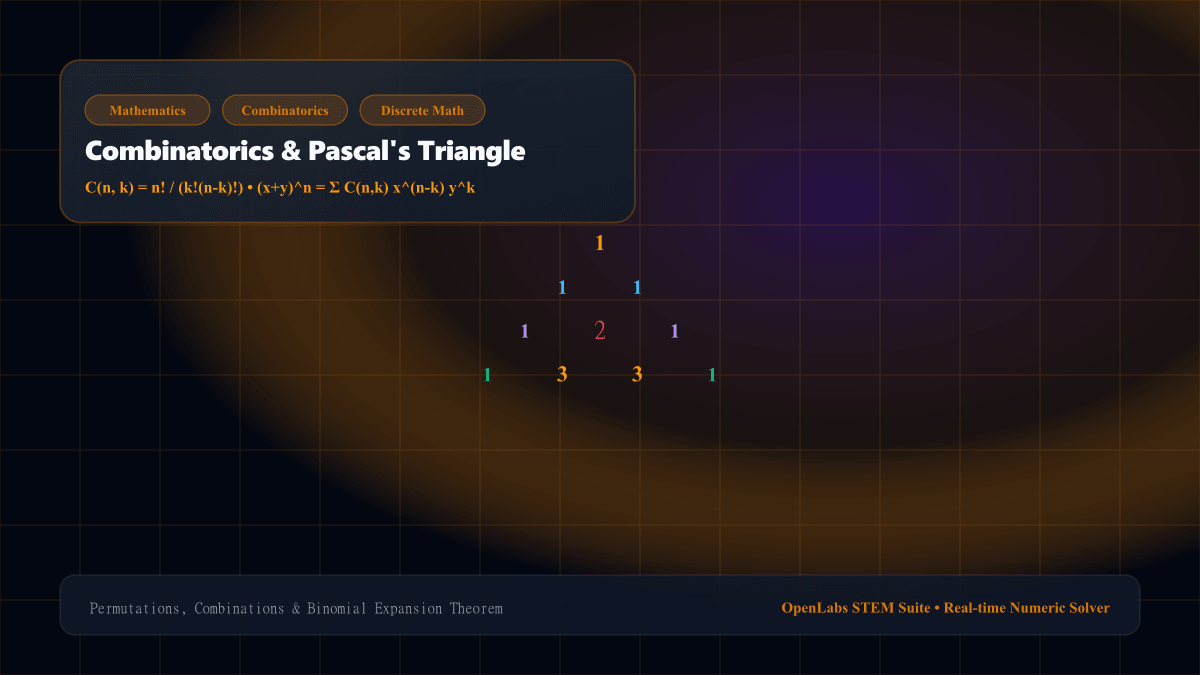
Combinatorics & Pascal's Binomial Triangle interactive Mathematics simulation illustration
Interactive Pascal Triangle & Subset GeneratorInteractive Rows n = 0 to 16 • Sierpiński Odd/Even Modulo Parity • Live Binomial Expansion Solver

Interactive Experiment Guide

Use this studio like a real-time mathematics workbench

Start with fundamental scientific principles, launch the simulation, and verify mathematical predictions against real-time outcomes.

DisciplineMathematics
Simulation ModeInteractive Numeric Engine
Governing ModelInteractive Pascal Triangle & Subset Generator
DeploymentIn-Browser WebAssembly / GPU
01

Scientific Foundation

What is combinatorics & pascal's binomial triangle?

Combinatorics investigates arrangements, selections, and structural properties of finite sets. The Fundamental Counting Principle states that independent sequential choices multiply (n₁ · n₂). Permutations count ordered arrangements (P(n, r) = n! / (n - r)!), while Combinations count unordered selections (C(n, r) = n! / (r!(n - r)!)). Pascal's Identity (C(n+1, k) = C(n, k-1) + C(n, k)) builds Pascal's Triangle, whose coefficients provide the exact expansion terms of (x + y)^n via the Binomial Theorem.

02

Interactive Simulation Flow

Experiment Execution & Governing Equations

Launch the simulation workspace, adjust parameters in real time, and observe the immediate response in the telemetry and graphical indicator loops.

Binomial Coefficient, Binomial Theorem & Power Set Identity\binom{n}{k} = \frac{n!}{k!(n-k)!} \quad \text{and} \quad (x+y)^n = \sum_{k=0}^n \binom{n}{k} x^{n-k} y^k \quad \text{and} \quad \sum_{k=0}^n \binom{n}{k} = 2^n

Frequently Asked Questions

Combinatorics & Pascal's Binomial Triangle FAQ

2 Answers

Coloring all the odd numbers in Pascal's Triangle with one color and all even numbers with another reveals the exact self-similar fractal pattern of the Sierpiński Triangle modulo 2.

Knowledge Graph & Related Concepts