MathematicsInteractive SimulatorZero Install100% Free

DifferentialEquations&DynamicalChaos

Explore the universal language of physical and biological change. Click to drop initial condition seeds into 2D vector slope fields, trace solution trajectories using Runge-Kutta integration, observe Lotka-Volterra predator-prey orbits, and watch chaotic butterfly orbits unfold on the 3D Lorenz attractor.

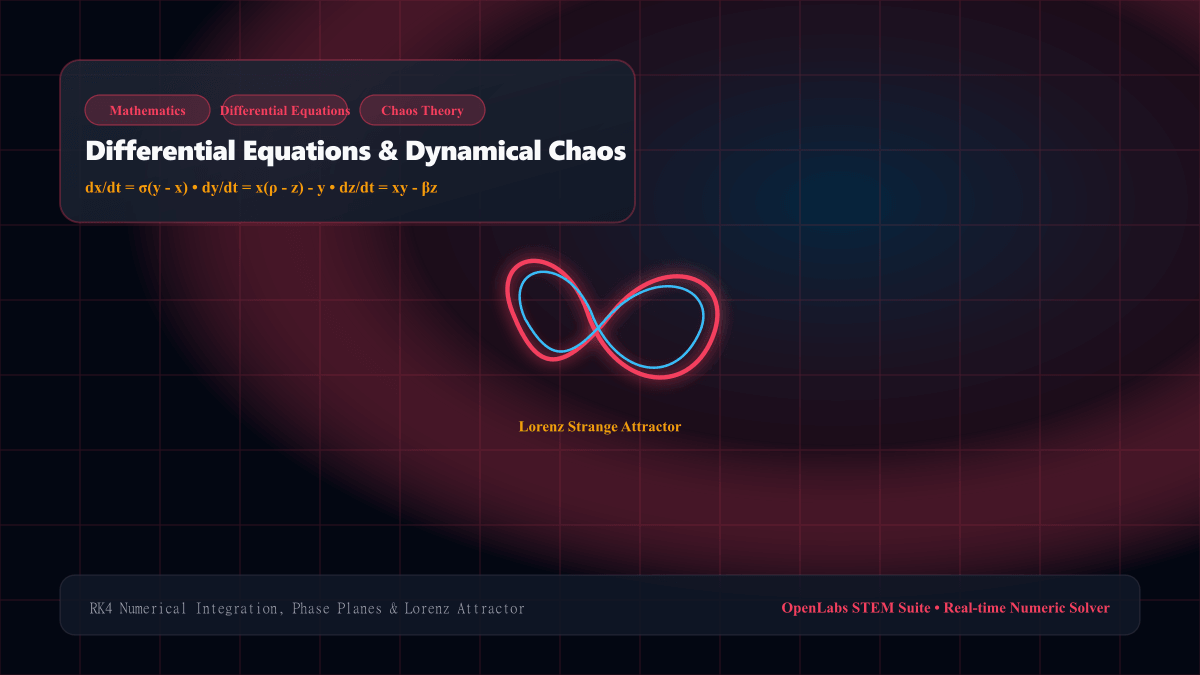
Differential Equations & Dynamical Chaos interactive Mathematics simulation illustration
Vector Slope Field & 3D Chaos Phase PortraitClick-to-Seed Integral Curves • RK4 Adaptive Step-Size Engine • 3D Lorenz Strange Attractor

Interactive Experiment Guide

Use this studio like a real-time mathematics workbench

Start with fundamental scientific principles, launch the simulation, and verify mathematical predictions against real-time outcomes.

DisciplineMathematics
Simulation ModeInteractive Numeric Engine
Governing ModelVector Slope Field & 3D Chaos Phase Portrait
DeploymentIn-Browser WebAssembly / GPU
01

Scientific Foundation

What is differential equations & dynamical chaos?

Differential equations relate unknown functions to their derivatives (rates of change). For nonlinear systems without closed-form analytical solutions, 4th-order Runge-Kutta (RK4) numerical integration approximates trajectories with high accuracy. In multi-variable autonomous dynamical systems (dx/dt = F(x)), fixed points and eigenvalues of the Jacobian matrix classify equilibrium stability (stable nodes, saddle points, spiral sinks, limit cycles). In deterministic chaotic systems (like the Lorenz atmospheric convection equations), solutions exhibit sensitive dependence on initial conditions (the Butterfly Effect).

02

Interactive Simulation Flow

Experiment Execution & Governing Equations

Launch the simulation workspace, adjust parameters in real time, and observe the immediate response in the telemetry and graphical indicator loops.

Lorenz Chaotic Attractor System & 4th-Order Runge-Kutta (RK4)\begin{cases} \dot{x} = \sigma(y - x) \\ \dot{y} = x(\rho - z) - y \\ \dot{z} = xy - \beta z \end{cases} \quad \text{and} \quad y_{n+1} = y_n + \frac{h}{6}(k_1 + 2k_2 + 2k_3 + k_4)

Frequently Asked Questions

Differential Equations & Dynamical Chaos FAQ

2 Answers

Discovered by meteorologist Edward Lorenz in 1963, deterministic chaos means that while a system is strictly governed by deterministic differential equations with no randomness, two starting trajectories with infinitesimal differences will diverge exponentially over time, making long-term prediction impossible.

Knowledge Graph & Related Concepts