MathematicsInteractive SimulatorZero Install100% Free

Probability,Statistics&CentralLimitTheorem

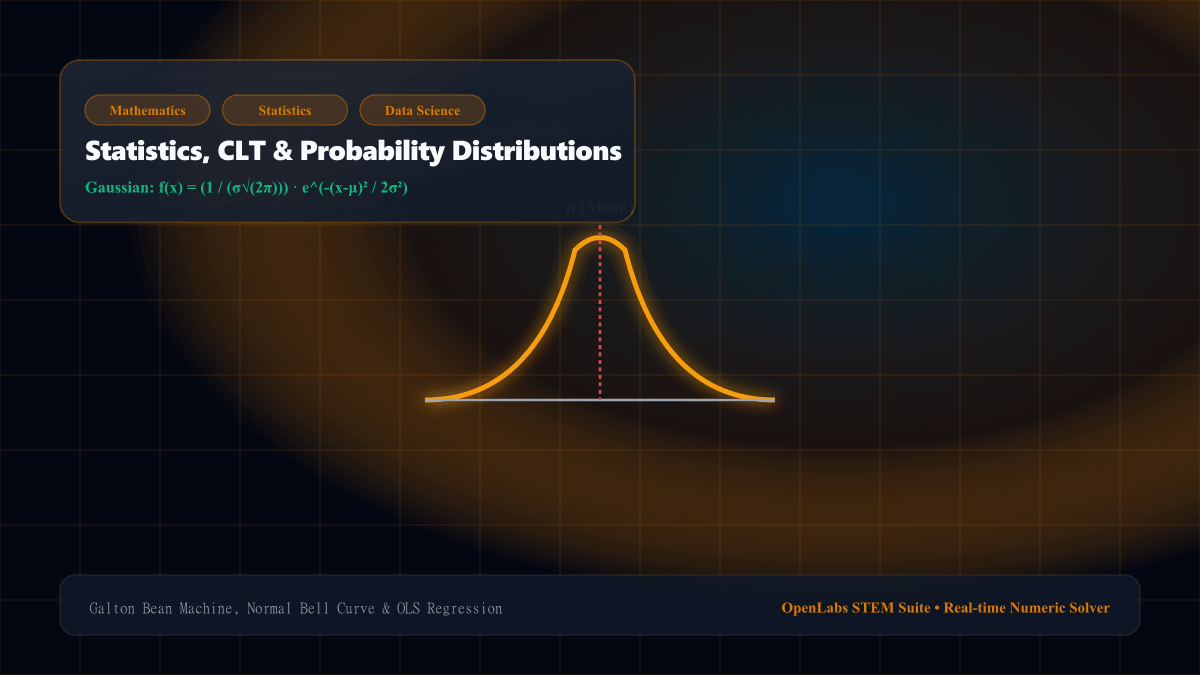
Bridge empirical random sampling and theoretical distributions. Drop thousands of steel balls through a physical Galton pin board, draw random sample means from skewed populations to observe the Central Limit Theorem in action, and fit linear regression trendlines.

Probability, Statistics & Central Limit Theorem interactive Mathematics simulation illustration
Galton Board & Central Limit Theorem EngineInteractive Bean Machine Drop • Uniform/Exponential/Bimodal Population Generators • OLS Scatter Plotter

Interactive Experiment Guide

Use this studio like a real-time mathematics workbench

Start with fundamental scientific principles, launch the simulation, and verify mathematical predictions against real-time outcomes.

DisciplineMathematics
Simulation ModeInteractive Numeric Engine
Governing ModelGalton Board & Central Limit Theorem Engine
DeploymentIn-Browser WebAssembly / GPU
01

Scientific Foundation

What is probability, statistics & central limit theorem?

Probability and Statistics provide the mathematical foundation for reasoning under uncertainty. The Central Limit Theorem (CLT) states that as sample size n increases (typically n ≥ 30), the sampling distribution of the sample mean (x̄) approaches a Gaussian Normal Distribution regardless of the underlying population's shape. In bivariate regression, Ordinary Least Squares (OLS) minimizes the sum of squared vertical residuals (errors) between observed points and the fitted trendline.

02

Interactive Simulation Flow

Experiment Execution & Governing Equations

Launch the simulation workspace, adjust parameters in real time, and observe the immediate response in the telemetry and graphical indicator loops.

Gaussian Probability Density & Central Limit Standard Errorf(x) = \frac{1}{\sigma \sqrt{2\pi}} e^{-\frac{(x - \mu)^2}{2\sigma^2}} \quad \text{and} \quad z = \frac{\bar{x} - \mu}{\sigma / \sqrt{n}} \quad \text{and} \quad \hat{\beta}_1 = \frac{\sum (x_i - \bar{x})(y_i - \bar{y})}{\sum (x_i - \bar{x})^2}

Frequently Asked Questions

Probability, Statistics & Central Limit Theorem FAQ

2 Answers

The CLT allows statisticians to make parametric inferences (such as confidence intervals and hypothesis tests) about population parameters even when the true population distribution is heavily skewed, bimodal, or unknown, provided the sample size n is sufficiently large.

Knowledge Graph & Related Concepts