MathematicsInteractive SimulatorZero Install100% Free

VectorAlgebra&3DSpaceProjections

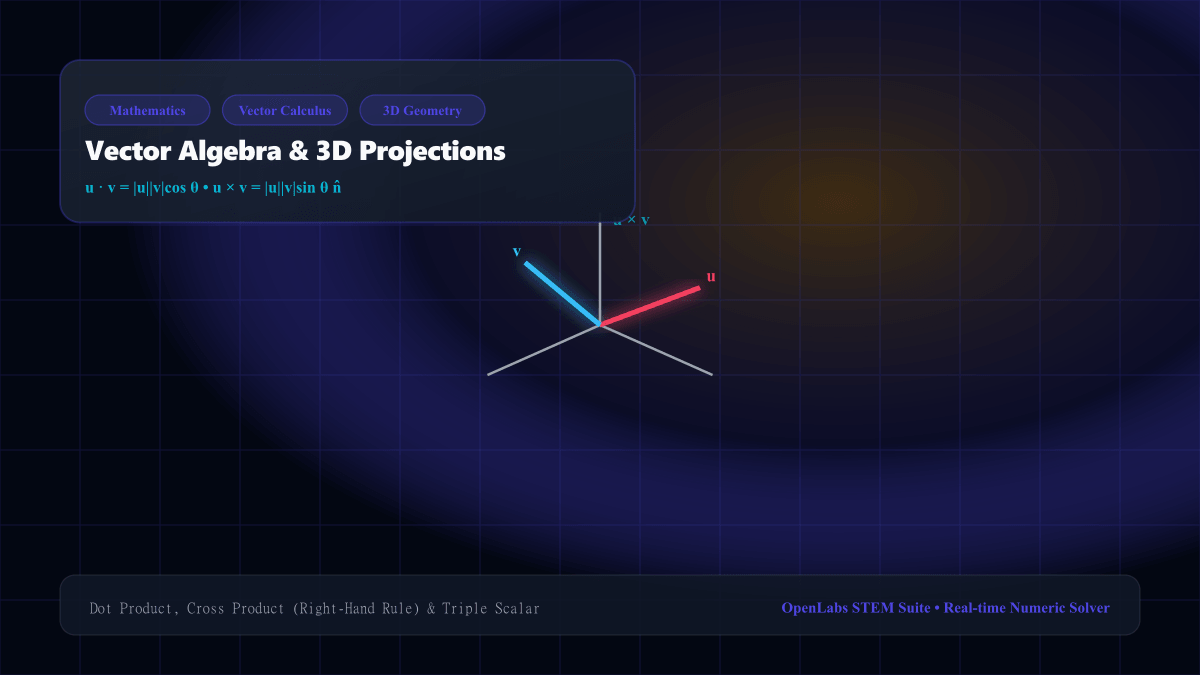
Master vector mechanics in 2D and 3D space. Drag vectors u and v to observe the Parallelogram Law of addition, compute orthogonal vector projections (proj_v u), rotate 3D vectors to test the Right-Hand Rule cross product (u × v), and calculate parallelepiped determinant volumes.

Vector Algebra & 3D Space Projections interactive Mathematics simulation illustration
2D / 3D Vector Workbench & ProjectionsInteractive Vector Dragger • Real-Time Orthogonal Projections • 3D Right-Hand Rule Cross Product

Interactive Experiment Guide

Use this studio like a real-time mathematics workbench

Start with fundamental scientific principles, launch the simulation, and verify mathematical predictions against real-time outcomes.

DisciplineMathematics
Simulation ModeInteractive Numeric Engine
Governing Model2D / 3D Vector Workbench & Projections
DeploymentIn-Browser WebAssembly / GPU
01

Scientific Foundation

What is vector algebra & 3d space projections?

A vector is a geometric entity possessing both magnitude and direction. The Dot Product (u · v = |u||v|cos θ) is an algebraic scalar measuring directional alignment, yielding zero for orthogonal perpendicular vectors. The Cross Product (u × v = |u||v|sin θ n̂) is a 3D vector perpendicular to both operands with magnitude equal to the area of the spanned parallelogram. The Scalar Triple Product u · (v × w) computes the signed volume of the spanned 3D parallelepiped.

02

Interactive Simulation Flow

Experiment Execution & Governing Equations

Launch the simulation workspace, adjust parameters in real time, and observe the immediate response in the telemetry and graphical indicator loops.

Dot Product, 3x3 Cross Product Determinant & Parallelepiped Volume\vec{u} \cdot \vec{v} = |\vec{u}||\vec{v}|\cos\theta \quad \text{and} \quad \vec{u} \times \vec{v} = \begin{vmatrix}\hat{\imath} & \hat{\jmath} & \hat{k} \\ u_x & u_y & u_z \\ v_x & v_y & v_z\end{vmatrix} \quad \text{and} \quad \text{Vol} = |\vec{u} \cdot (\vec{v} \times \vec{w})|

Frequently Asked Questions

Vector Algebra & 3D Space Projections FAQ

2 Answers

By the Right-Hand Rule, reversing the order of the vectors (from u toward v to v toward u) flips the direction your thumb points by 180°, which negates the resulting normal vector: v × u = -(u × v).

Knowledge Graph & Related Concepts