01
Scientific Foundation
What is doppler effect & sonic boom?
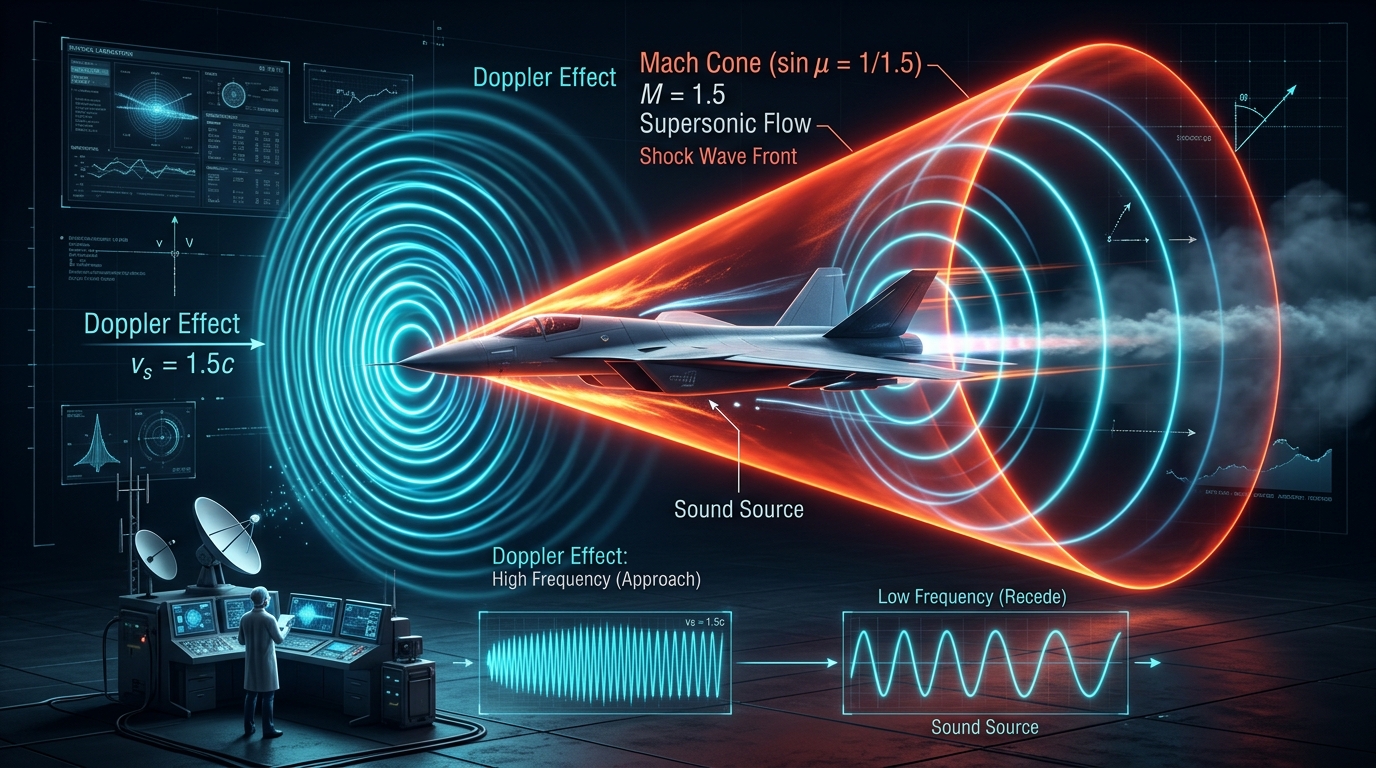
The Doppler effect is the change in observed frequency of a wave when the source and observer are in relative motion. For a moving sound source in a stationary medium, emitted spherical wavefronts bunch together in front of the source (shortening the wavelength to λ_f = (c - v_s)/f₀) and spread out behind it (lengthening to λ_b = (c + v_s)/f₀). At supersonic velocities (v_s ≥ c, Mach M ≥ 1), the source outruns its own pressure waves, creating a conical shock front whose envelope forms the classic Mach cone with half-angle sin(μ) = 1/M = c/v_s.