PhysicsInteractive SimulatorZero Install100% Free

KeplerOrbit&GravitationalMechanics

Explore celestial mechanics with interactive elliptical orbits. Adjust semi-major axis, eccentricity, and stellar mass to observe real-time planetary velocity vectors, perihelion speedups, and Kepler's harmonic law.

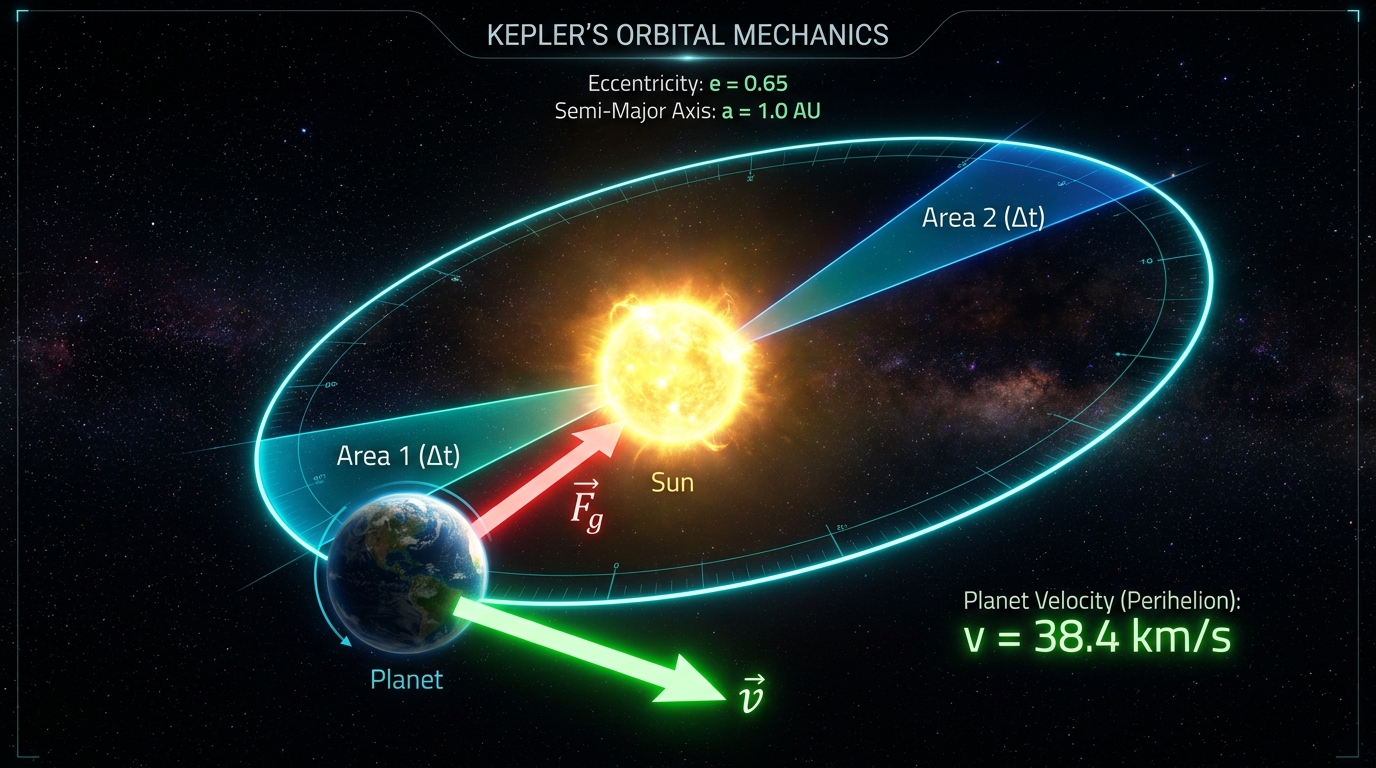
Kepler Orbit & Gravitational Mechanics interactive Physics simulation illustration
Precision Analytical Kepler Orbit EngineNewton-Raphson Kepler Solver • Live Swept Sectors • Dynamic Vector Overlays

Interactive Experiment Guide

Use this studio like a real-time physics workbench

Start with fundamental scientific principles, launch the simulation, and verify mathematical predictions against real-time outcomes.

DisciplinePhysics
Simulation ModeInteractive Numeric Engine
Governing ModelPrecision Analytical Kepler Orbit Engine
DeploymentIn-Browser WebAssembly / GPU
01

Scientific Foundation

What is kepler orbit & gravitational mechanics?

Johannes Kepler formulated three empirical laws governing planetary orbits around the Sun: (1) The Law of Ellipses states that orbits are elliptical with the central star at one focus. (2) The Law of Equal Areas states that a line segment joining a planet to the star sweeps out equal areas during equal intervals of time (dA/dt = L/2m = constant), proving angular momentum conservation. (3) The Harmonic Law states that the square of the orbital period is directly proportional to the cube of the semi-major axis (T² = [4π²/GM]·a³).

02

Interactive Simulation Flow

Experiment Execution & Governing Equations

Launch the simulation workspace, adjust parameters in real time, and observe the immediate response in the telemetry and graphical indicator loops.

Kepler's Harmonic Law & Vis-Viva EquationT^2 = \frac{4\pi^2}{G M} a^3 \quad \text{and} \quad v = \sqrt{G M \left(\frac{2}{r} - \frac{1}{a}\right)}

Frequently Asked Questions

Kepler Orbit & Gravitational Mechanics FAQ

3 Answers

Because total mechanical energy (E = -GM/2a) and angular momentum (L = m·r·v_perp = constant) are conserved in a central gravitational field. As the planet gets closer to the star (smaller r), gravitational potential energy becomes more negative, converting into higher kinetic energy (higher speed v).

Knowledge Graph & Related Concepts