PhysicsInteractive SimulatorZero Install100% Free

PhotoelectricEffect

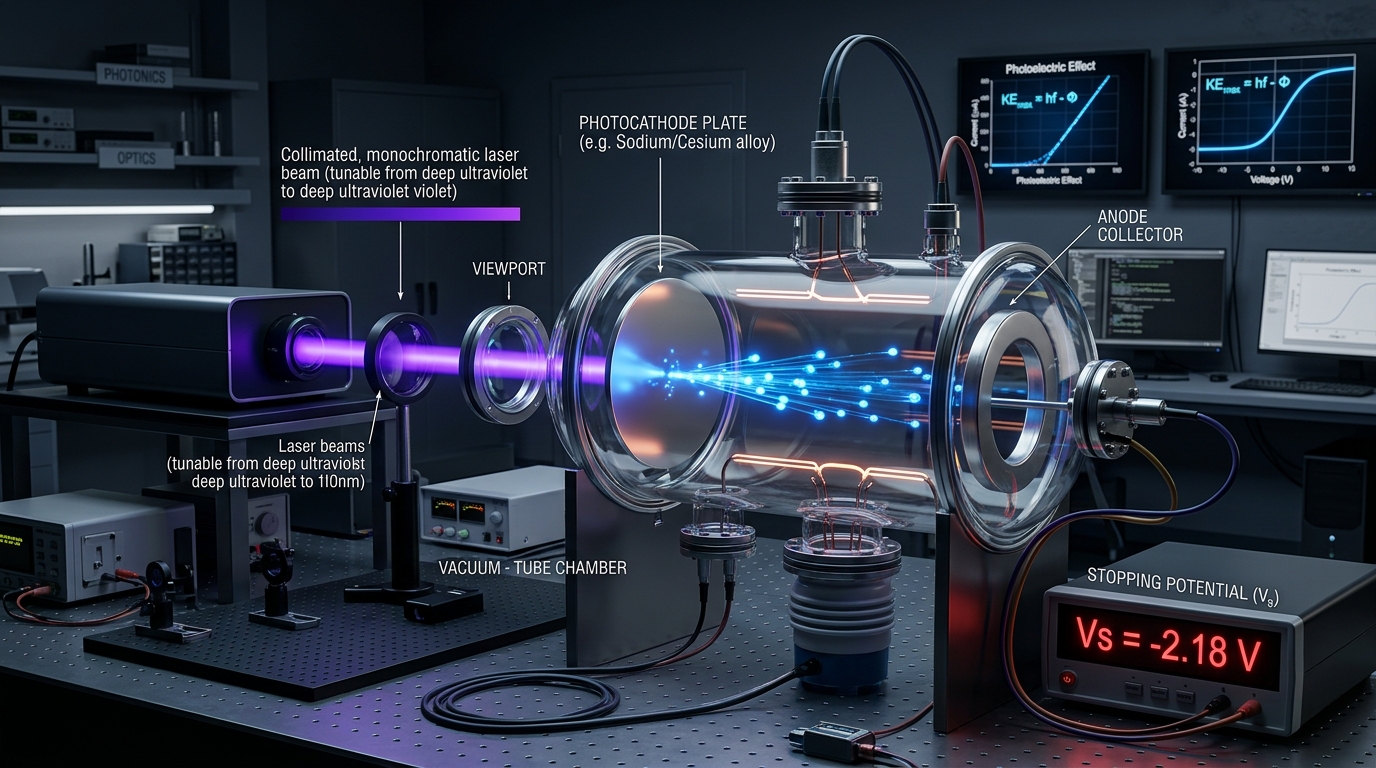
Recreate the Nobel Prize-winning experiment that proved light quantization. Shine monochromatic light (200 nm UV to 750 nm Red) onto photocathode metals, adjust retarding stopping voltage, and measure maximum photoelectron kinetic energy.

Photoelectric Effect interactive Physics simulation illustration
Quantum phototube modelPhoton wavelength, work function, stopping voltage

Interactive Experiment Guide

Use this studio like a real-time physics workbench

Start with fundamental scientific principles, launch the simulation, and verify mathematical predictions against real-time outcomes.

DisciplinePhysics
Simulation ModeInteractive Numeric Engine
Governing ModelQuantum phototube model
DeploymentIn-Browser WebAssembly / GPU
01

Scientific Foundation

What is photoelectric effect?

The photoelectric effect demonstrates the particle nature of light. When photons strike a metal surface, their energy (E = hf) is transferred in single quanta to liberate electrons above the work function threshold.

02

Interactive Simulation Flow

Experiment Execution & Governing Equations

Launch the simulation workspace, adjust parameters in real time, and observe the immediate response in the telemetry and graphical indicator loops.

Einstein's photoelectric equationK_{\\text{max}} = h\\nu - \\Phi = e V_s

Frequently Asked Questions

Photoelectric Effect FAQ

4 Answers

Einstein's equation states that the maximum kinetic energy (K_max) of an emitted photoelectron equals the incident photon energy (hf) minus the metal's work function (Φ): K_max = hf - Φ = e·Vs.

Knowledge Graph & Related Concepts