PhysicsInteractive SimulatorZero Install100% Free

ThermodynamicHeatEngines

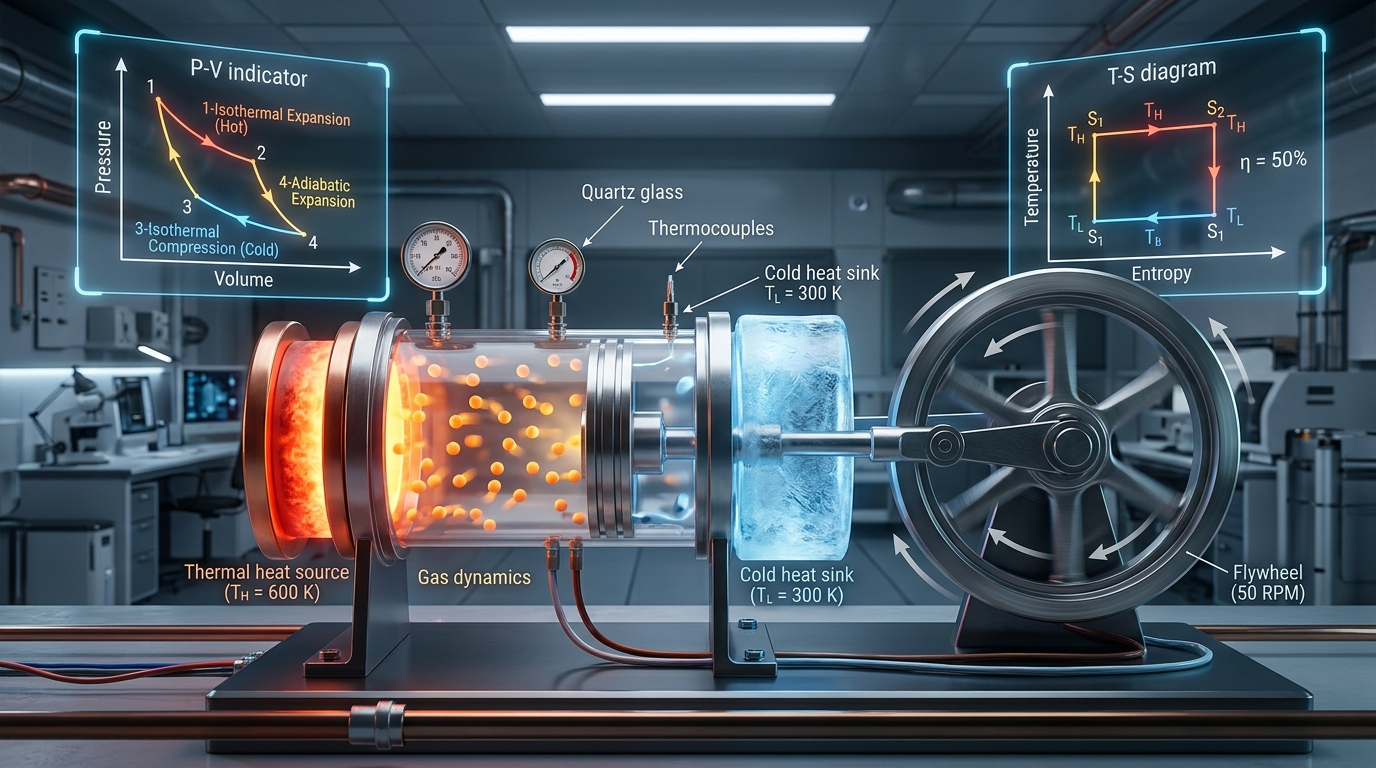
Operate virtual heat engines across Carnot, Otto, and Diesel cycles. Adjust hot and cold reservoir temperatures, observe real-time piston-crankshaft rotation, and trace closed P-V indicator loops to calculate net work output and thermal efficiency.

Thermodynamic Heat Engines interactive Physics simulation illustration
Thermodynamic engine cylinderP-V indicator loop, T-S entropy plot, flywheel RPM

Interactive Experiment Guide

Use this studio like a real-time physics workbench

Start with fundamental scientific principles, launch the simulation, and verify mathematical predictions against real-time outcomes.

DisciplinePhysics
Simulation ModeInteractive Numeric Engine
Governing ModelThermodynamic engine cylinder
DeploymentIn-Browser WebAssembly / GPU
01

Scientific Foundation

What is thermodynamic heat engines?

Heat engines convert thermal energy from a high-temperature reservoir into mechanical work, rejecting waste heat to a cold reservoir. The Second Law of Thermodynamics dictates that theoretical maximum efficiency is governed by the Carnot limit.

02

Interactive Simulation Flow

Experiment Execution & Governing Equations

Launch the simulation workspace, adjust parameters in real time, and observe the immediate response in the telemetry and graphical indicator loops.

Carnot thermal efficiency limit\\eta_{\\text{Carnot}} = 1 - \\frac{T_C}{T_H}

Frequently Asked Questions

Thermodynamic Heat Engines FAQ

4 Answers

A Carnot engine operates on an idealized, fully reversible four-stage thermodynamic cycle (two isothermals and two adiabatics). Because all heat transfers occur reversibly without generating universe entropy, its efficiency (η = 1 - TC/TH) sets the strict upper bound for any heat engine operating between two thermal reservoirs.

Knowledge Graph & Related Concepts