PhysicsInteractive SimulatorZero Install100% Free

GeometricOptics&LensRayTracing

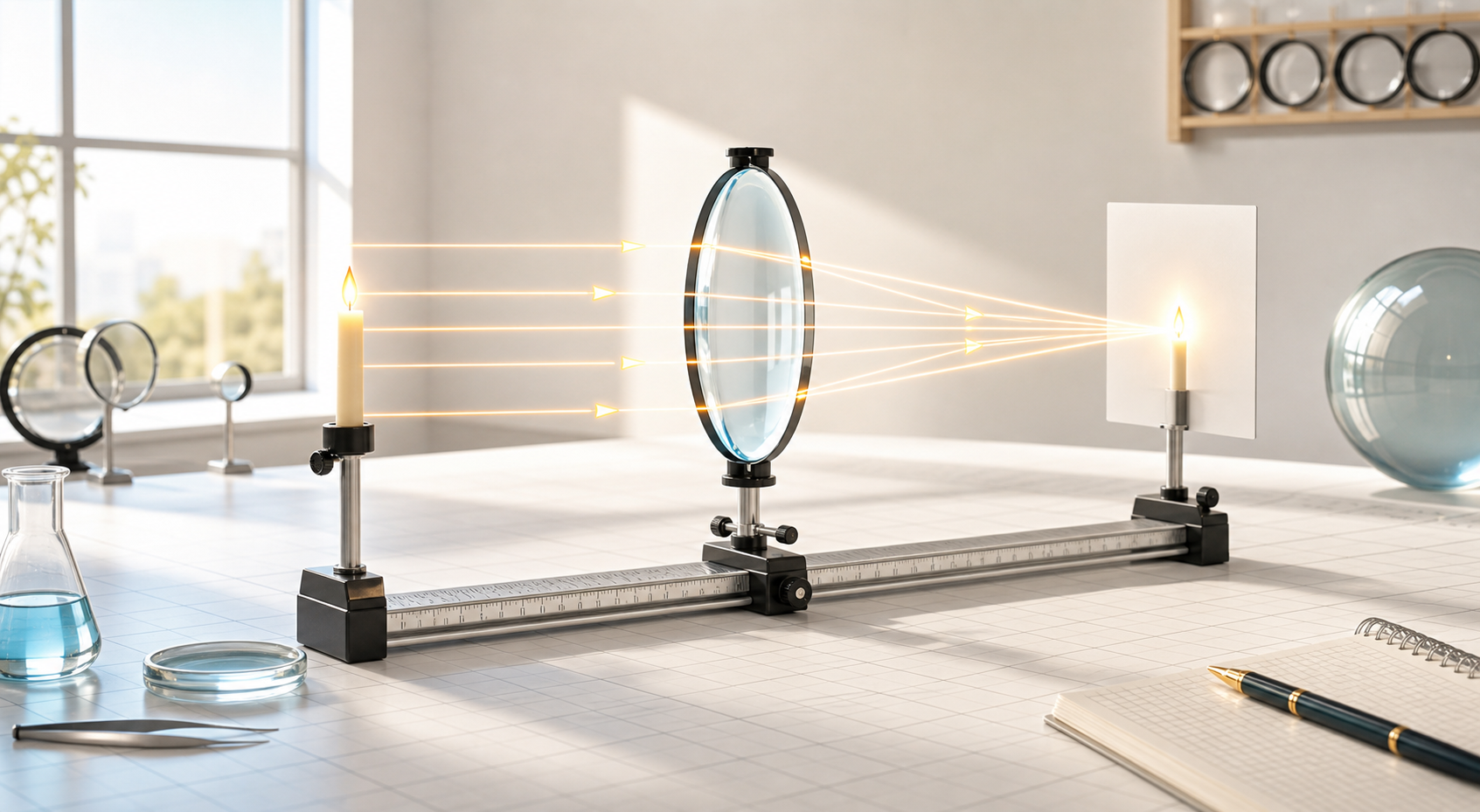
Operate a virtual precision optical bench. Experiment with convex converging and concave diverging lenses, trace three color-coded principal rays (Parallel, Focal, and Chief rays), simulate real and virtual image formation, and calculate refractive power in diopters.

Geometric Optics & Lens Ray Tracing interactive Physics simulation illustration
Optical Ray TracerFocal length f, object distance dₒ, principal rays, refractive index n

Interactive Experiment Guide

Use this studio like a real-time physics workbench

Start with fundamental scientific principles, launch the simulation, and verify mathematical predictions against real-time outcomes.

DisciplinePhysics
Simulation ModeInteractive Numeric Engine
Governing ModelOptical Ray Tracer
DeploymentIn-Browser WebAssembly / GPU
01

Scientific Foundation

What is geometric optics & lens ray tracing?

Geometric optics models light propagation as straight rays that refract at curved dielectric boundaries. The Gaussian thin-lens equation 1/f = 1/d_o + 1/d_i relates focal length f, object distance d_o, and image distance d_i. The transverse magnification M = -d_i / d_o determines image size and orientation. For a lens with radii of curvature R₁ and R₂ in a medium of refractive index n, focal length is governed by the Lensmaker's equation: 1/f = (n - 1)(1/R₁ - 1/R₂).

02

Interactive Simulation Flow

Experiment Execution & Governing Equations

Launch the simulation workspace, adjust parameters in real time, and observe the immediate response in the telemetry and graphical indicator loops.

Gaussian Thin Lens & Transverse Magnification Equations1/f = 1/dₒ + 1/dᵢ \quad \text{and} \quad M = -dᵢ / dₒ = hᵢ / hₒ

Frequently Asked Questions

Geometric Optics & Lens Ray Tracing FAQ

4 Answers

A real image is formed by actual physical light rays converging at a focal point; it is always inverted relative to the object and can be cast onto a projection screen or camera sensor. A virtual image occurs when light rays diverge after passing through the lens; human eyes perceive them as originating from a point behind the lens, producing an upright image that cannot be captured on a physical screen.

Knowledge Graph & Related Concepts

Next Steps in Learning